
As wild as it seems, we can trace back the invention of jet engines to 150 BC with the development of the aeolipile. And it is truly the aeolipile’s technology that allowed Dr. Hans von Ohain and Sir Frank Whittle to invent the jet engine as we know it today, albeit it separately and unbeknownst to each other. Additionally, it was Sir Frank Whittle’s jet engine that provided the United States of America the initial technology to build their own jet engines.

Sir Frank Whittle was an English aviation engineer as well as a test pilot in the Royal Air Force. It was in 1930 that he received his first patent on turbojet propulsion and, in just ten short years, he was able to construct, prove out, and secure his first contract of purchase for what was then called the W1 Whittle engine. It was May 1941 when the first historic flight with this new technology occurred.

This leads us to the fall of 1941 when a group of GE engineers in Lynn, Massachusetts received a secret present from King George VI via wooden crates on aircraft, as part of a contract from the U.S. War Department. Inside of the crates were parts of the first jet engine ever flown by the allies; a Whittle engine. The goal of this gift? To improve the handmade engine, bring it to mass production and help win the war.

Over 1000 people worked on the clandestine project, but only a select few knew the goal and what was being built. Those that did know were told they couldn’t talk to anyone about the work being performed. If they did, the consequence was death. As a result, they were called the “Hush-Hush Boys.

With a timeline of 6 months, the team of engineers and technicians were tasked with redesigning the jet engine for commercialization. The accomplishment was completed in five months and in the fall of 1942, the first official aircraft flight occurred, powered by two jet engines, producing a total of 2,600 pounds of thrust. 

Interested in learning more? I highly recommend the following.

  • Read here about Joseph Sorota, the last of the Hush-Hush boys and a key player in this engineering feat.
  • Find an image of the first US Jet Engine here as well as a magnificent video made by GE.
 

The Jet Story:


The manufacturing industry is one of America’s great invisible strengths. They keep our stores stocked, our transportation systems running, and our people employed. And while this entire industry could use better recognition, today’s article will focus solely on Black Owned Manufacturing Companies that are experiencing tremendous growth.

Electro Soft Inc

Located in Pennsylvania, this family-owned manufacturer has over 35 years of experience creating customized electronics for a variety of industries including aviation, defense, and transit. They offer a plethora of services such as custom panel builds, cable assembly, wire harness assembly, PCB builds, and military electronics. They do all of this while highlighting Just In Time (JIT) Delivery to increase productivity.

James Wallace became an innovator at a young age after inventing his own air conditioner. How did he do it? He utilized his existing fridge and converted it into an air conditioner. Later in life, he pursued an engineering degree at Penn State and created his first design debugging secure communications equipment for the National Security Agency. His daughter also started her career at an early age. Karla would cut wires at home, making ten cents an hour, and later in life she worked at every business location her family opened. She graduated college with a focus on business, shipping operations, and logistics. The family legacy continued onward and is still expanding today. They are known for their specialty services and quality production.

Find out more about their history here.

Maroon Sausage Company

This gem is right in the heart of Brooklyn, New York.

Howard Allen founded Maroon Sausage Company when he fell in love with the diverse populations surrounding him. As a result, he drafted a dream plan for the company to begin. His desire to bring Jamaican food to the local market while also offering it to surrounding markets online. To do just that, he created the perfect product… Jamaican Jerk Chicken Sausage.

Brooklyn has jerk chicken everywhere – the environment made it accessible, but Howard and his friend created the idea of having a mobile food business. The only requirement? It had to be sausage. They knew of a similar company, but they also knew they could take it to a whole new level. In 2014, the project became solely Howard’s as his friend stopped the project to follow a new path. Daily, Howard still tried to curate the beloved recipe they have on the market today. The esteemed judges (his children and mother-in-law) became quality testers until he took his product to the streets by hosting tables at local markets.

Did he have a cooking background? Nope, this creative director took his marketing skills to a new level by creating a holistic project. They held fundraisers during food truck events in support of halting human trafficking, and this turned into a weekly partnership as his company grew in the city.

Get ahold of some sausage of your own here.

Nerrido Foods

While we’re on the topic of food, let’s talk about the Nigerian delight of Nerrido foods. Ufuoma Okharedia, a mother and wife, is the CEO and Founder of Nerrido. When she left Nigeria, she realized there was a gap with availability to traditional African meals. She sought to create accessible authentic African foods and sourced authentic ingredients locally. As a result, she shared her joy of cooking online while also selling blends of tomato stew for jollof rice. This sauce is all in one: pasta, curry, pizza, jollof rice, you name it!

Not only did she share her joy of cooking, but she also began to teach others how to make traditional and authentic dishes. This enabled her to bring the Nigerian tradition overseas while creating access for others to do the same. Ufuoma aims to inspire others to cook with confidence.

Shop online here.

Takeaway

Manufacturing is truly for everyone, whether you start with an idea sketched onto a napkin or pursued a technical degree. As a society, we need to do a better job of acknowledging how greatly this industry affects each of us. Without modern manufacturing, our technology, education, and scientific knowledge would stall completely, our daily lives would look vastly different, and we wouldn’t be as connected as we are today.

Don’t be afraid to get started in the skilled trades world. Not sure where to start? Connect with us, and we’ll help get you there.

Other Honorable Mentions

How It’s Made – Plastic

Plastic has been around for much longer than most of us know. In its earliest form (some say as early as 1600 B.C.), plastic was produced by Mesoamericans who harvested latex from the Panama Rubber Tree and processed it with liquid from the Morning Glory Vine. However, the production of plastic (as we now know it) started many years later when Polyvinyl Chloride (PVC) was invented during the 1930s. Since then, there have been other types of plastic discovered and invented with each having its own strengths and weaknesses, which ultimately determine the end use.

So, how is it made?

Step 1: Raw Material Extractions

Crude oil and natural gas are extracted (drilled) from the ground then transported to a refinery.

Step 2: Refining

During the refining process, these natural materials are turned into multiple products including ethane and propane (which are the foundation of plastics). The refining process is very similar to how gasoline is made. With the assistance of a high-temperature furnaces, as well as pressure, ethane and propane are broken down into smaller molecules creating ethylene and propylene.

Step 3: Polymerization

In this stage, catalysts (a.k.a. chemicals) are added into the process and bond individual molecules into a polymer. When heated, polymers are incredibly moldable, making them great for plastic products. There are two ways in which this polymerization process can occur, and each way makes its own polymer (or resin), and each resin has its own set of pros and cons (which ultimately determines the end product it’s used in). You can find resin types in the Resin Identification Codes (RICs) on plastic products. Resins include Polyethylene Terephthalate (PET), High-Density Polyethylene (HDPE), Polyvinyl Chloride (PVC) and Polystyrene (PS) among others. PET is the most commonly used plastic in the world.

Step 4: Nurdle Making

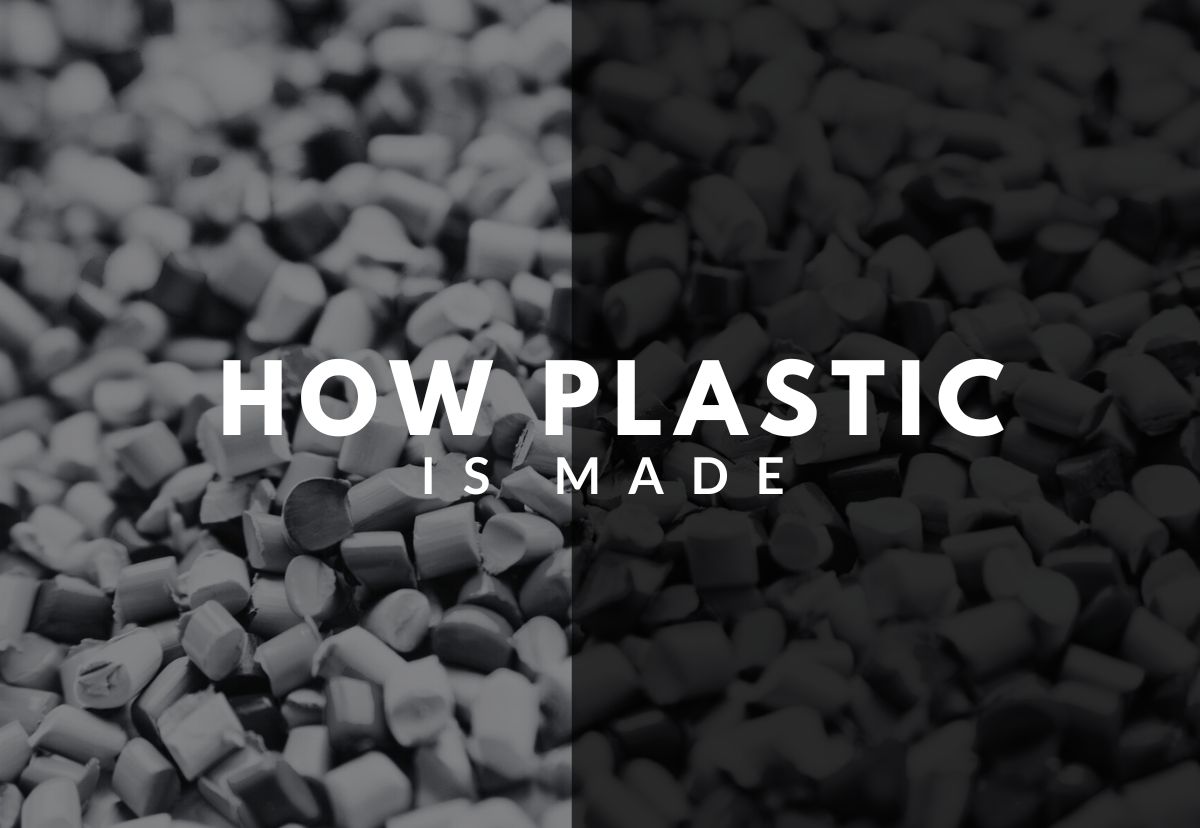
You read that right… now it’s on to nurdle making! Nurdles are little plastic pellets made from the resins created in the polymerization process. The process to do so is through melting and cooling operations. Once these lentil-sized pellets are produced, they are shipped from a petrochemical refining facility to manufacturing facilities where they are melted down and formed into a final product.

Step 5: Plastic Forming & Fabrication

Manufacturers compound, mix, and melt the plastic pellets with other ingredients to very specific recipes. When followed, these recipes determine the characteristics and properties of the plastic product. The melted plastic is then formed into shape by plastic forming machinery, which is determined by the application of the product.

Common Machinery Used to Form Rigid Plastic Products Includes:

  • Injection Molding
  • Extrusion Molding
  • Blow Molding
  • Compression Molding
  • Thermoforming
  • Rotational (Roto) Molding
  • Polymer Casting

If you are a plastics manufacturing company, or someone who has worked in a plastics manufacturing facility, you likely fully understand this process. If not, check out our blog page to see what else we can help you understand better. Regardless of where you rate your plastics knowledge, keep reading because did you know that FlexTrades can help you find the right people for your company and/or the right job for yourself, too, regardless of industry? Check us out online at FlexTrades.com to learn about all that we can do for you.

Manufacturing as an industry has taken some hits over the years, but it’s always proven to be very resilient. Even with the pandemic, the threat of a recession, a retiring (and limited) workforce, as well as supply chain issues, manufacturing came out stronger on the other side of it all. In fact, Deloitte forecasted a 2.5% growth in GDP for 2023. How about that for resilience?

Listed below are four ways manufacturing will stay strong and come out ahead in 2023… and beyond.

Technology:

5G networks, cyber security, cloud adoption, IOT (the Internet of Things), AI (Artificial Intelligence), AR (Augmented Reality), and VR (Virtual Reality) are all investments that manufacturers are finding value in. The implementation of this technology enhances efficiency and effectiveness across the production floor.

Supply Chain Review:

The pandemic really brought out flaws in supply chain management as it relates to manufacturers. As a result, companies are reassessing their supply chain and looking toward ways to become more supply chain resilient. By diversifying vendors and vendor locations, manufacturers will still experience disruptions but not at the levels witnessed in 2020.

Smart Factories:

Manufacturers are seeing that implementing smart technology in their production process reduces operating costs while also improving efficiency. And rather than implement it piece-by-piece, manufacturers are adopting the technology system-wide, wherever possible.

Data & Analytics:

Manufacturers are focused on collecting data. Data, when combined with analytics and technology, provides manufacturers with an opportunity to understand their operations more accurately than ever before. This allows them to see actionable insights in real time without high costs and long waits. In fact, this market is forecasted to grow by 16.5% CAGR (compound annual growth rate) between 2019 and 2026.

What It All Means:

So, what does this mean?

In short, it means that skilled trade work isn’t going away. It means skilled trades workers will still be needed because manufacturing will continue to prove its resiliency and, as a result, continue to grow.

Join the FlexTrades team today to experience top notch pay, the opportunity to travel, and the ability to work and learn new skills with some of the greatest manufacturers in the United States. If you’re new(er) to manufacturing, don’t worry – we have that covered too. Join our ReTool team for the opportunity to upskill and train for the dream job you desire. And if you’re a manufacturer yourself, consider FlexTrades as a labor solutions provider.

When COVID-19 hit, consumers and manufacturers alike quickly learned just how fragile the global supply chain was. They also learned just how important supply chain resilience is. Let’s talk about both now.

What is Supply Chain Resilience?

Supply chain resilience is the ability to withstand and minimize the effects of supply chain disruptions. It is planning and preparing for possible disruptions; the goal of which being fast response and recovery when those disruptions occur. It is not being invincible to interruptions but rather being able to overcome them without a big impact to operations and / or customer deadlines. But how is supply chain resilience accomplished? That’s a great question. Supply chain resilience is going to require big changes by manufactures in three key areas… technology, processes, and people.

Technology:

Supply Chain Technology

Reviewing old technology, adopting new technology, and always looking for emerging technologies is critical. Technologies that help overcome supply disruptions include:

  • Real-time analytical tools
  • ERPs (Enterprise Resource Planning software that manages the entire business from finance, human resources, manufacturing, supply chain, procurement, and more).
  • Artificial Intelligence (AI)
  • Robotics or Automated Systems
  • Digital Manufacturing Systems
  • Cryptocurrency like the blockchain
  • Integration of systems and software across the supply chain including those from suppliers, warehouse systems, stores/customers, etc…

Processes:

Supply Chain Process

New Forecasting Techniques:

  • Oftentimes, company forecasts focus on their own needs as it relates to demand. If demand is this, we need to do this. But companies need to dig deeper than that. Dig into what the supply chain looks like for suppliers, the demands and risks suppliers could be facing and how those demands and risks will affect operations.
  • Note: It’s very important to truly understand the products and goods that bring the most value to an organization. Build a commodity management strategy for these products which essentially allows for the management and coordination of all items related to these key products, including procurement, production, and distribution. This can be helpful when facing an inevitable disruption to the supply chain.

Build In Inventory Buffers:

  • Yes, it can be costly to no longer operate in a just-in-time fashion, but what’s even more costly is missed deliveries and lost customers when there’s no inventory.
  • Supplier Diversification: This could mean asking existing partners to supply parts from a wider variety of manufacturing locations, or it could mean adding in new suppliers with locations and processes different than that of current suppliers.
  • Note: To implement multi-sourcing, calculate the revenue impact of the disruptive event (i.e., natural disaster, global or localized pandemic) that occurred.

Nearshoring or Reshoring:

  • Upon first thought, nearshoring seems to be the opposite of supplier diversification. Many believe supplier diversification means offshore suppliers, but a diversified supply chain is one that focuses on companies locally, regionally, domestically, and globally. The local and regional level can be more expensive, but it also shortens both cycle and delivery times.

People:

Supply Chain People

  • Build relationships with 3PLs and contract manufacturers. Diversifying partnerships with 3PLs is vital to the distribution of product, and contracting other manufacturers for the production of a product is important, too.
  • Upskilling: A manufacturer’s workforce is critical to surviving supply chain disruptions. A cross-trained workforce lessens the need to be reactive in hiring and eases challenges caused by supply chain issues.
  • Create a commodity management team and a supplier management team. These two teams understand supply chain to its fullest, its pricing (particularly as it relates to demand), and the general manufacturing market while also building great relationships with suppliers for mutual benefit in the future.

Enacting these tools takes time, attention and money in the short term, and it’s hard to commit to spending more money now for a potential risk in the future but the risk is ultimately worth the investment.

What do you think? Do you have any question? Feel free to reach me anytime at kmooney@flextrades.com.

On February 24, 2022, Russia launched a military invasion in Ukraine. The unrest continues today. 

As a defense partner and military ally to Ukraine, (the United States established diplomatic relations with Ukraine in 1991 following Ukraine’s independence from the Soviet Union), companies like ours have committed time, energy and resources by providing aid, financial assistance and delivering humanitarian support in Ukraine.

In fact, on February 28, 2023, Ukrainian President, Volodymyr Zelenskyy, addressed American businesses during the National Association of Manufacturers (NAM) board meeting. NAM CEO, Jay Timmons, stated “Manufacturers in America will continue to stand with Ukraine.”  

Here are a few examples of American manufacturers supporting Ukraine during this war.  

  1. In Manitowoc, Wisconsin, the Wisconsin Aluminum Foundry Co. (WAFCO) drastically increased their production efforts to build 3,000 medical sterilizers for UNICEF. UNICEF has been buying sterilizers from this company since the 1970s. 
  2. MSA Safety Incorporate is a leader in the development and manufacturing of safety solutions and products to protect people and infrastructure. Core products include self-contained breathing apparatuses, gas and flame detection systems, and fire and rescue helmets. To support the war on Ukraine, MSA Safety Incorporate donated over $400,000 worth of safety equipment to Ukrainian firefighters.  
  3. Schweitzer Engineering Laboratories (SEL) is a leading American company specializing in digital products and systems that protect, control, and automate power systems with the goal of preventing blackouts and improving power system reliability. With their expertise in hand, SEL manufactured equipment to help monitor and manage substation equipment in Ukraine.  
  4. In the small town of Lima, Ohio, there is a big production facility (25-acres large) doing big things. In this building, owned by the Army and operated by General Dynamics, you can find about 800 skilled trades personnel disassembling Abrams tanks down to the hull and rebuilding them until they’re good as new again.  
  5. AeroVironment out of Arlington, Virginia, generously donated unmanned aircraft systems and drones in addition to ramping up production to meet contract requirements with The Defense Department. This isn’t surprising considering their support after 9/11 led them to become the world leader in small, unmanned aircraft systems (UAS).  
  6. General Electric’s Gas Power division has partnered with the U.S. Agency for International Development (USAID) to manufacture for and supply Ukraine a mobile gas turbine power plant. By doing so, this piece of equipment could supply at least 100,000 homes with electricity as well as hospitals, schools, and other critical infrastructure.  
  7. In addition to all of these, MANY manufacturers have committed hundreds of thousands, even millions, of dollars to Ukraine to support efforts in defense, rebuilding, emergency and medical services. Check out this list of manufacturers who have already donated and pledged to continue to donate until the war is over.  

Of course, this isn’t all the companies in the U.S. supporting Ukraine. Even if we tried to list them all, we wouldn’t be able to. Manufacturing is a complex and interwoven industry supplying anything and everything during war and peacetime.   

If you’re looking to support Ukraine, a great place to start is here. 

In general, there are two types of job markets, a candidate-driven jobs market and an employer-driven jobs market. As it stands today, the United States is in a candidate-driven jobs market, but what is that and what does it mean?

What is a Candidate-Driven Jobs Market?

A candidate-driven jobs market happens when candidates have the upper hand. What this means is that jobs are abundant and employees (candidates) call the shots.

What Does a Candidate-Driven Jobs Market Mean for Employers?

  • It’s time to rethink compensation. Where can improvements be made? Is company-wide compensation equal or better than the competition?
  • Candidates are prepared to negotiate pay, perks, and benefits. Companies should be willing to negotiate and also willing to concede, if necessary.
  • Reconsider the years of experience required. This invites those with fewer years of experience to apply and, oftentimes, it’s those applicants who are most eager to do the job.
  • Make sure that there is room for advancement. Having an upskilling path and a plan for the advancement of every employee is critical to retaining employees.
  • Think again about the critical skills needed in a role. Are there any “must-haves” that aren’t really “must-haves?” Make those skills a “nice-to-have,” and watch the applications roll in.
  • Not everyone is actively looking for a new job. Targeting passive candidates who aren’t seeking new jobs may be interested in what else is available.

Recruiting Top Talent is Hard

In this market, it can be hard to recruit (and retain) top talent. That’s where FlexTrades comes in. With our technical knowledge and team of skilled technicians located nationwide, we can help you and your company find the people you need to continue thriving. Contact FlexTrades today to learn how we can help your company bridge the gap between where you are now and where you want to be as a manufacturer.

Spanning the course of history and all around the world, innovative women have changed lives with their ideas and inventions. To celebrate and honor them this month (National Women Inventors Month), we’re sharing the stories behind seven female inventors who changed the course of history. 

Margaret E. Knight (1838 – 1914)


Margaret “Mattie” Knight, born in York, Maine is said to have invented over 100 different machines and patented at least 20, including the first machine to cut, fold and glue paper into flat-bottomed paper bags. In 1867, Mattie began working at the Columbia Paper Bag Company in Springfield, MA where bags were cut, folded, and glued by hand. This got Mattie thinking there had to be a better way. Just one short year later, she invented and built a fully functional machine for cutting, folding, and gluing paper bags. It’s said this machine replaced the work of thirty people. I believe it’s likely saved many from irritating papercuts too!  

Josephine Cochrane (1839 – 1913)

Josephine Cochrane 

Josephine Cochrane was a 19th century socialite who realized a need for her invention after noticing her heirloom dishes were left chipped from washings. However, her idea was just that – an idea, until she was suddenly left widowed and in debt. Realizing she needed to do something grand, she pursued the dishwasher idea, received a patent for it in 1886, and an award at the 1893 Chicago World’s Fair. She went on to start up Cochrane’s Crescent Washing Machine Company, which sold dishwashers commercially. Upon her death, the company was purchased by KitchenAid, a Whirlpool Corporation.   

Hedy Lamarr (1914 – 2000)

Hedy Lamarr 

Hedy Lamarr (full name Hedwig Eva Maria Kiesler) was born in Vienna, Austria. She had a successful film career in Czechoslovakia, and after meeting an MGM studio head in Paris, emigrated to the United States. She went on to star in many successful films from 1930 to 1960. It was during this time (and World War II) that Hedy read about enemy interference with the guidance system of radio-controlled torpedoes. With this information in hand, Hedy raised the idea that a frequency-hopping signal might prevent the interference. In 1942, Hedy received the patent for her technology. It was adopted by the U.S. Navy in 1960 and is the basis of the principles behind Bluetooth and GPS technology.   

Bette Nesmith Graham (1924 – 1980)

Bette Nesmith Graham 

Have you ever made a mistake and wished you could erase it? As a typist, Bette Nesmith Graham made plenty of mistakes but found the process to correct them difficult with the technology of typewriters at the time. Bette’s inspiration came after noticing painters were correcting their mistakes by simply covering it up with more paint. As a result, Bette decided she’d use a tempera, water-based paint (matched to the color of her stationery) to correct her typing mistakes. Over time, she saw her actions go unnoticed by her boss. Soon after she started using her corrective tool, a colleague requested her own bottle which Bette shared and labeled with “Mistake Out.”  With a little more refining (in her kitchen laboratory), and assistance from a paint company employee and a chemistry teacher at a local school, Bette finally started her company and continued production from her kitchen. With patent in hand (and a new name – Liquid Paper), Bette moved from the kitchen to her backyard, and eventually to a house, where she began selling Liquid Paper. By 1967, it was a million-dollar business. 12 short years later, Bette sold the company to Gillette for $47.5 million dollars!   

Dr. Temple Grandin (1947)

Dr. Temple Grandin 

Dr. Temple Grandin has a Ph.D. in animal science and is a world-renowned speaker and teacher.  She invented animal handling and restraint systems, including the center track restraining system, used to handle nearly half of all cattle in North America during the slaughtering process. What’s even more amazing about Dr. Grandin is she’s done great things with what some may consider a limitation. You see, after failing to speak for the first few years of her life, Dr. Grandin was diagnosed with “brain damage” at the age of two. Misbelieving this diagnoses, Grandin’s mother continued to pursue other explanations through connections with therapists, neurologists, and researchers. Without an understanding of Grandin’s medical needs, school and relationships were hard for her.  It was while Grandin was in her mid-teens, her mother came upon a checklist for autism symptoms and determined that Grandin must be autistic. Grandin went on to receive a formal diagnosis as an adult. To this day, she is an author, expert, and spokeswoman for autism.   

Stephanie Kwolek (1923 – 2014) 

Stephanie Kwolek 

What is lightweight and durable while also cut-resistant and heat-resistant? Kevlar. And, thanks to Stephanie Kwolek, as well as a coincidence or two, we have it. Stephanie began her early life pining for the medical field, and even after graduating with a B.A. in chemistry from Carnegie Mellon University, it was still her intent. But a chance opportunity to take a job at Dupont (a chemical company) led Stephanie down a very different path. Stephanie began working at Dupont with the goal of making enough money to continue her education. However, she found polymer-chemistry very interesting and ended up staying with Dupont for 40 years. During this time, not only did she invent Kevlar, but she also contributed to other products like Spandex (Lycra) and Nomex and successfully secured 28 total patents. Today, we see Kevlar in more than 200 applications including body armor, PPE, aircraft composites, automotive components, conveyor belts for industrial applications, work gloves, ropes, and cables.   

Ruth Wakefield (1903 – 1977)

Ruth Wakefield

When we think of inventions, we don’t always think of food, but foods can be an invention, too. Ruth Wakefield was a dietician and lecturer during a time when most women were considered homemakers, so food was always on her mind. After purchasing a tourist lodge in Massachusetts with her husband, which they named the Toll House Inn, Ruth took on the task of creating and preparing recipes and meals for the guests. One such recipe was for a thin, butterscotch, nut cookie that was served with ice cream. Everyone loved it, but Ruth wanted something else. She decided she’d add Baker’s chocolate (unsweetened, no milk or flavoring) to the butterscotch batter, but soon found out she had none. She turned to a Nestle, semisweet candy bar which she broke into pieces with an ice pick expecting that the chocolate would melt into the dough. However, it didn’t, and she now had what we call chocolate chip cookies. Ruth called these new cookies Toll House Crunch Cookies and word spread. NESTLÉ® sales went up and product changes were made, eventually turning bars of chocolate into chips of chocolate. Soon enough, NESTLÉ® approached Wakefield (some say Wakefield approached NESTLÉ®) and a partnership was formed. Wakefield’s recipe would be printed on the back of all chocolate chip packaging, she’d receive a $1 payment for the rights, a lifetime supply of chocolate, and the opportunity to consult with NESTLÉ® on other recipes. Find the NESTLÉ®  Toll House Original Chocolate Chip Cookie recipe here.