Today, September 22nd, is American Businesswomen’s Day! This day was made to honor the women in our workforce and the impact that they have created. Observing this day allows women of many different occupations, cultures, and networks to celebrate one another.  

Here are some ways that you can celebrate the women in our workforce:  

  • Find women owned companies to visit and give them your business!  
  • Network with women in your industry and seek a woman outside of your industry to grow your female business connections.  
  • Listen to a Podcast produced by a woman.  
  • Donate to a local college that has a woman in business club.  
  • Find a women owned nonprofit to donate/volunteer at. Dress For Success is a great organization to investigate.   
  • Encourage your company to partner with a woman in business development group.  
  • Watch this Ted Talk by Diana Nyad, to listen to her story and become reinspired to “Never Give Up”.  

We are proud of the women in our workforce and proud that many women are prominent leaders in their industries. It is no longer uncommon for women to be commanders in the business world and that alone is something worth celebrating!  

As a working parent, a celebration for ‘Working Parents Day’ (I say with sarcastic air quotes) seems like extra work, because I know I’m the one throwing the party or begging my kids to give me a break. Considering so many of us live a working parent’s life every day (more than 60% of U.S. families have working parents or dual earners), I will admit I appreciate the idea that our children should take 24 hours to reflect on all we have sacrificed for them and celebrate it on a day other than the 2nd Sunday in May or the 3rd Sunday in June. (End sarcastic tone… 😊) 


When my husband and I started talking about having kids early in our relationship, I knew being a stay-at-home mom was not going to be something that kept me satisfied. Stay-at-home parents are a special kind of person. I absolutely look up to them and admire them, but I knew I didn’t have it in me to be one of them. 


Fast forward to our children being born. Heading back to work after 12-weeks of leave was really difficult but it was something I knew I had to do for my own sanity. When we moved from central Illinois to the Minneapolis metro when our youngest was just 6 months old, the cost of living more than doubled and it felt like every kid in my daughter’s preschool class had a mom who stayed home and could volunteer at every teachers request. I struggled with what the expectation was of our community and if we were going to be able to give our children everything they needed while both my husband and I worked all day. 


Today, as our girls head back to middle school, I appreciate the fact that I have a success story to share with them, so they know what they are capable of. That you can go from working at a truck-stop diner right out of high school and finally graduating with your bachelor’s when you are 27 years old, to being the Director of Human Resources at a really great company that appreciates the importance of quality time with your family. I get to show them every day what being a successful businesswoman looks like and to the same effect, their father does too, just with his own story to back it up.  


In the end, I feel like Working Parent’s Day (minus the sarcastic air quotes this time) is almost more of a day for me to appreciate myself: that I’ve done everything I’ve done to be a positive example for my children. I must preface that by saying stay-at-home parents likely feel the exact same way, and for goodness sakes, they absolutely should feel that way – what they do is a full-time job as well. What it really comes down to is that I’m happy doing what I do every day and I get to share with my girl’s what happiness at work looks like.  


If you are like most of us, you will not find happiness and contentment in your first job, or your second job, or your third job, or even your tenth job but you will find it if you keep following your passion and doing what feels good to you. Just keep doing what you believe in, and all that work will pay off in the end. And then, that’s when you get to throw yourself that party or ask for a break.

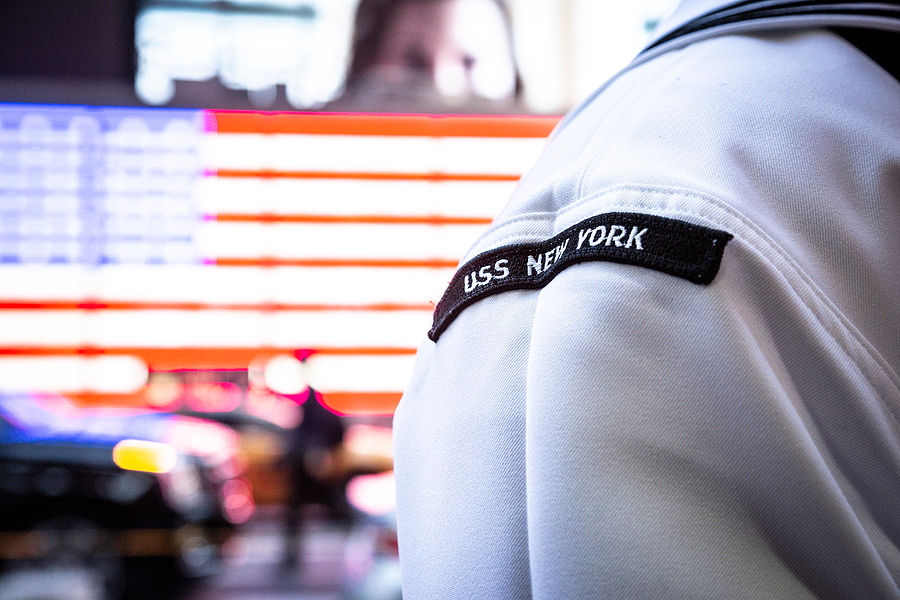
On September 11th, 2001, the unthinkable happened when four airplanes were hijacked by militants associated with the extremist group al Qaeda. Of the four planes, two were flown into the twin towers of the World Trade Center in New York City.  Almost 3,000 people were killed during these terrorist attacks resulting in not only major US initiatives to fight terrorism but also paths of grief for all Americans. To recognize that grief and commemorate the victims of these 9/11 attacks, the U.S. Navy commissioned the USS New York (LPD-21), one of six Navy ships with New York in the name. This ship was different though. This ship, the USS New York (LPD-21) is a massive ship with 7.5 tons of steel recovered from the World Trade Center and Ground Zero. The steel is forged into its bow of the ship which is significant. It symbolizes the strength and resiliency of citizens as the ship sails forward, around the world. In fact, the motto of the USS New York (LPD-21) is “Strength forged through sacrifice. Never forget.”  

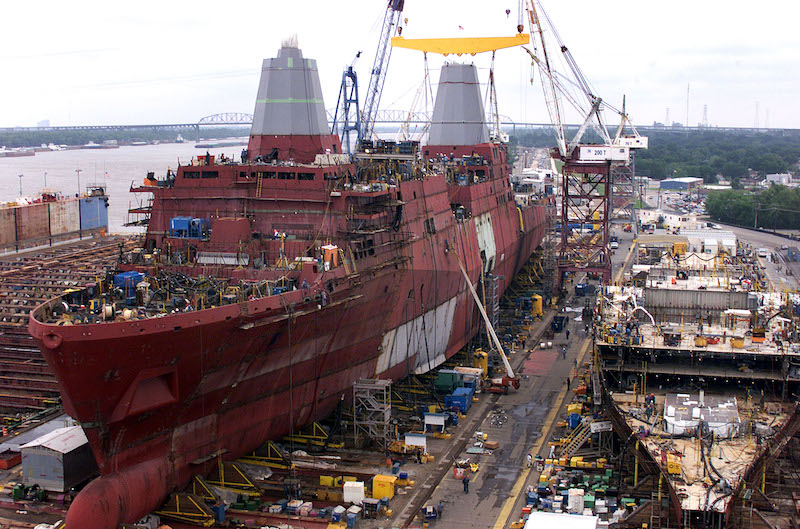
Although named after New York, the USS New York (LPD-21) was not constructed there. This mighty ship was constructed at the Northrop Grumman Ship Systems/Avondale Shipyard in Avondale, Louisiana.

Avondale Shipyard sold, now called Avondale Marine | WorkBoat 

The steel from Ground Zero was melted down at Amite Foundry and Machine in Amite, Louisiana. Not only was Amite Foundry and Machine close to the shipyard, they also had the capacity to do a job of this size. You could say the foundry specializes in jobs of this size. They’ve been known to turn down molding jobs for product weighing less than 1,000 pounds and are also known to make mold products that weigh as much 119,000 pounds. Depending upon the economy, Amite Foundry and Machine has a goal of producing 24 million pounds of metal per year. How did they make the bow stem? By melting a total of 24 tons of steel (7.5 tons of that being from Ground Zero) and molding it into the bow stem. With the bow being front and center of the ship, the steel from Ground Zero will lead the way everywhere it goes.  

With the bow completed, the rest of the ship was constructed. To construct a ship, the process starts with steel plates longer and wider than an average bus. These plates are cut into panels, bent on hydraulic presses to match the shape of the ship (or rolled to form the needed contour). Once formed, these panels are painted then welded together to form sub-assemblies of the ship. Once complete, the sub-assemblies are moved by large cranes and transport vehicles across the shipyard to the final build location of the ship. While all of this is occurring, the ship is also built out with internal mechanisms, equipment, cabling, etc. You can find a great video of this process (and really understand the sheer size of the process) here. Once the ship is close to being completed, it will be launched into the ocean where the final touches are added internally and it’s prepped to start sail.  

Final touches include:  

  • A New York City subway sign from the station beneath the World Trade Center  
  • A display case of hats and uniforms from first responders (including a firefighter’s helmet) 
  • A mural of the twin towers with the words Never Forget 
  • A banner with the many  names of the victims of 9/11 

A general timeline of the USS New York (LPD-21) is as follows:  

  1. August 2002: New York’s Governor (George e. Pataki) receive approval for his request that a United States surface warship bestow the name of New York to honor the victims of 9/11. 
  2. August 2003: Northrop Grumman Ship Systems is awarded the contract to build the USS New York (LPD-21). 
  3. September 2003: Amite Foundry and Machine melted steel down to form the bow stem of the ship.   
  4. March 2008: the USS New York (LPD-21) was christened in a ceremony at shipyard. 
  5. August 2009: the ship was delivered to the Navy. 
  6. October 2009: the ship set sail for Norfolk, Virginia.  
  7. November 2009: the ship passed the World Trade Center site for the first time. 
  8. November 2009: a commissioning ceremony took place in New York City.
     

From the very beginning to the very end, it took 7 years to build out this magnificent ship. There were many hands involved in the process including those who poured the metal at an unheard-of foundry in Louisiana to every welder who brought the plates together down to the last crew member to board the ship. This 9/11, let’s remember those who made this memorial ship possible in addition to the first. 


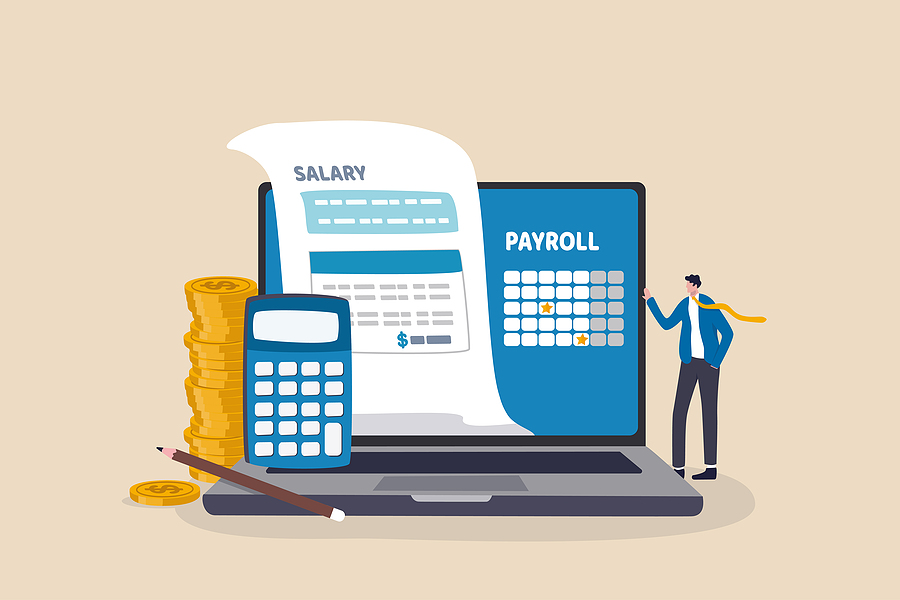
This week was National Payroll Week which is observed in recognition of all employees and the payroll professionals who pay them. These groups are put together because they collectively handle, report, contribute or otherwise touch 70% of the US Treasury’s annual revenue. Wow! In honor of the week, we asked our accounting department what they think your accounting department wants you to know. We learned 5 big things from them. 

Regularly Review Your Pay Stub 

This is not only to ensure your pay is accurate either. Things to review include other pay items such as deductions and taxes. 

Please be sure to send any updates, changes, or information as soon as possible. There is processing time between when information is received to funds being paid, and this will help ensure timely inclusion in payroll. 

Make Sure to Keep Them Updated 

Please be sure to send any updates, changes or information as soon as possible. There is processing time between when information is received to funds being paid, and this will help ensure timely inclusion in payroll. 

It’s Just Math 

“Accountants aren’t any more qualified than you to divvy up the bill at a restaurant.” Bring a calculator and figure out the tip yourself. You’ve got this. 

Fun Fact 

The most common pay frequency in the U.S. is biweekly, which is used by 37 percent of private businesses. Surprisingly, weekly beats semimonthly as a runner-up at 32 percent. 

More Tips & Tricks 

I hope you found value in this list. If you’d like to learn more about your accounting department, give them a call or email and I bet you’ll be glad you did. If you’d like more lists check out our blog page to see more. Did we miss something about accounting that you’d like to share? We’d love to help you do that! Send to our Writing Team and we’ll be happy to share them in a future blog. Stay cool and be safe this summer!

The prices at the pumps have been higher than ever recently. In fact, US gas prices were the highest they’ve ever been which has many people wondering why they’re high and if the prices will go down. Some are also wondering how it’s made. In reality, the two go hand-in-hand.  


Gasoline is made from crude oil (also known as petroleum). Crude oil (or petroleum) is a fossil fuel which means it is produced from the remains of plants and animals. These plants and animals lived millions of years ago and are covered by sediment which when exposed to weather, erosion, and other environmental factors, produces hydrocarbons.


Hydrocarbons can be liquid or gas. In this case, due to high pressure levels, the hydrocarbons formed under the ground are liquid hydrocarbons. These liquid hydrocarbons are what we know as crude oil (or petroleum). So, how does that become gasoline for vehicles? Let’s check it out!  

Step One 

When a crude oil source is found, drilling begins. Drills bore holes under the surface of the Earth in the area where crude oil has been found. Fun fact: these drills can go as far as one mile deep! The hole created by the drill acts as a well. With the addition of water into the soil, mud is created and this mud pushes cracked rock to the top of the hole at which point it is removed. This also ensures the crude oil stays below the surface. Once it has been determined the reservoir is ready for oil extraction, a pipe is inserted into the hole.  

Step Two  

This pipe is called a casing. This casing has holes in it that allow oil from the reservoir to enter the pipe and bring the oil to the surface of the Earth. Once recovered, the crude oil is stored in large tanks. From those tanks, oil is transported to a refinery via pipeline, ship, or tank cars on rail.  

Step Three 

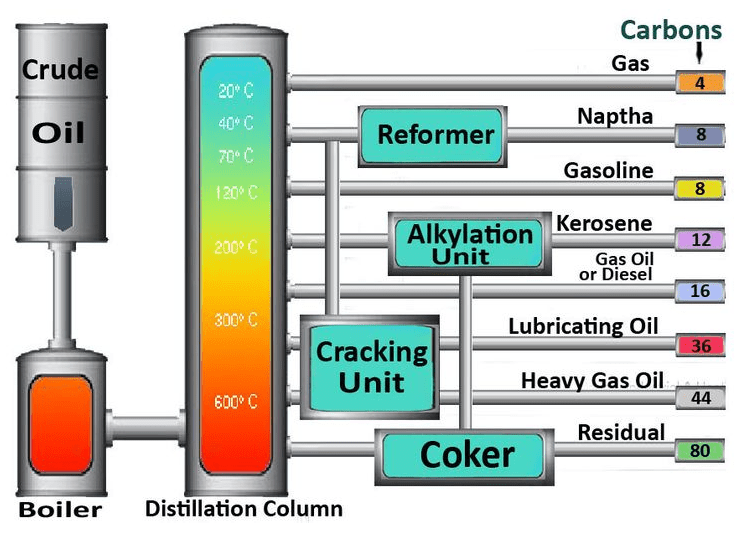
At the refinery, crude oil is broken down into a variety of other materials to include gasoline and diesel fuel. In fact, gasoline was discovered when crude oil was originally refined to produce oil and kerosene for lamps, prior to the invention of electricity. With the addition of heat (ranging from roughly 60 degrees Fahrenheit to 1100+ degrees Fahrenheit), crude oil is distilled. Distillation is where we create the various byproducts of crude oil. The byproducts made are dependent upon carbon atoms. Remember, crude oil consists of liquid hydrocarbons. Hydrocarbons consist of carbon atoms that link together. These links of carbon atoms can vary in length and depending upon the length, will have different properties, characteristics, or behaviors. 


Examples of these chains: a chain with one carbon atom is known as methane. Kerosene consists of 12-15 atom atoms in one chain. The more atoms in one chain, the heavier the byproduct. 

Oil Distillation Process

Step Four 

Once distilled, the byproducts require further refining. Additional refining processes include catalytic cracking, coking, reforming, and alkylation. These are all fancy words that describe the different ways in which the crude oil coming out of the distillation column is further refined and purified. Once finished, it is sent to refinery storage tanks.  

Step Five  

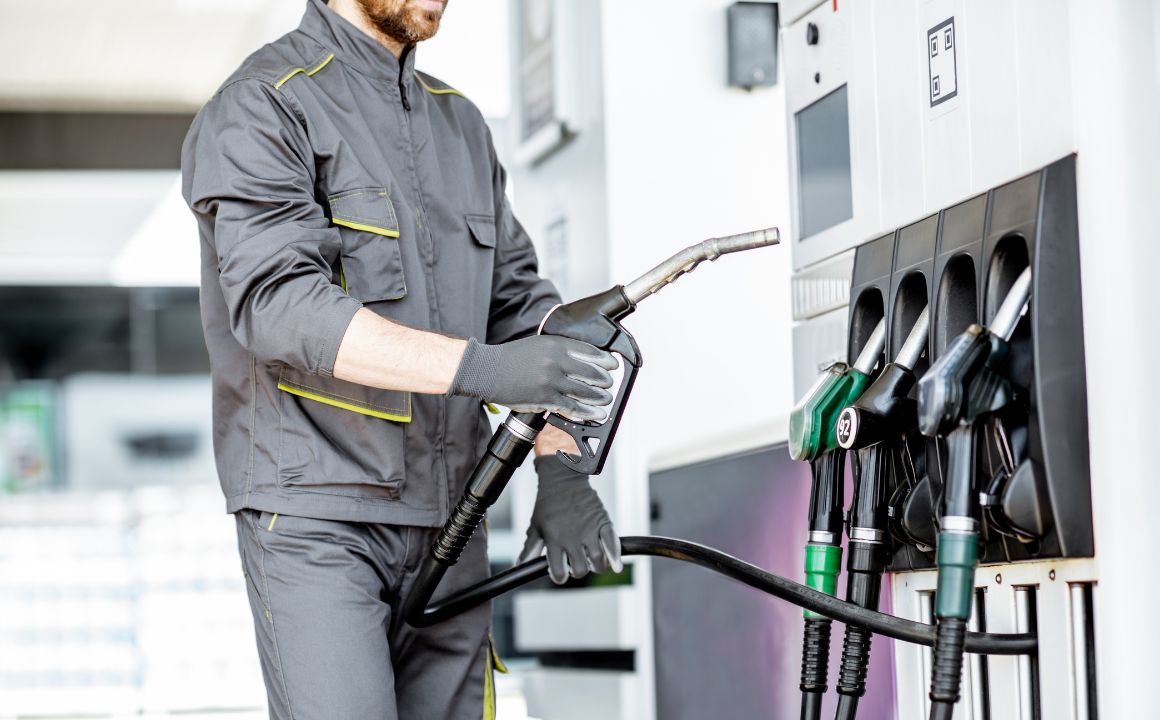
This step is all about blending. From the refinery storage tanks, gasoline is sent to smaller blending tanks via tanker, barge, or pipeline. Here, gasoline is typically blended with ethanol. Blending is done to create different grades of gas. Remember, when you pull up to the pump at a gas station, you see a variety of options. Diesel, E87, E88, etc. These are the grades of gasoline. Different grades of gasoline are made to meet different performance requirements of a vehicle. An example of this is gasoline produced for use in the winter. To improve a vehicle’s ability to start with a cold engine, gasoline is blended to a consistency in which it will vaporize more easily

Step Six 

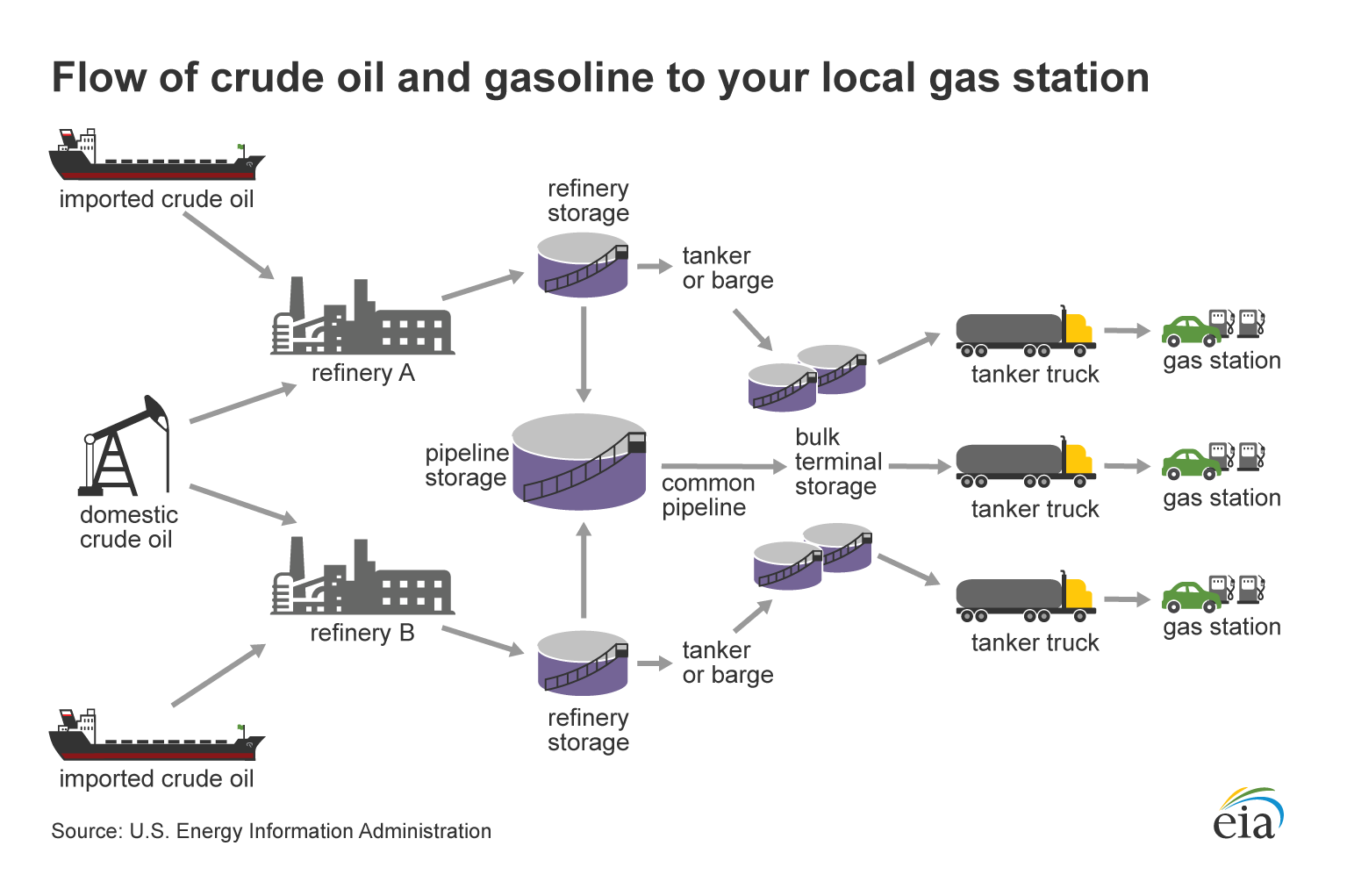
Once blended and ready for use, tanker trucks deliver the finished fuel to a gas station. The gasoline is stored in tanks underground at each gas station and from these tanks, are pumped up and out of the gas pump once you start it up. If you’re interested in more about that process, check out this article from howstuffworks.com. 

Flow of Crude oil and Gasoline to your pump

So, how does this all tie into the cost of gasoline prices? Well, it comes down to supply and demand. If supply is low but demand is high, prices are higher too. Therefore, if we are not drilling (onshore or offshore) for crude oil or if we are not receiving imported crude oil, we are not refining. If we aren’t refining, the supply is low while demand stays the same or increases. Of course, drilling is a hot button topic and when it comes to importing, supply chain and geopolitical events (which we’ve recently seen) will decrease supply. Thus, gasoline prices and gasoline production go hand-in-hand.

Personnel Management Group Inc. 

7/25/2022 


PMG, Inc. Announces Rebrand to FlexTrades 

PMG built our reputation on the flexibility of our skilled trades technicians and the solutions they help us provide to the American manufacturing industry. Now we want that flexibility to be evident from the first time you hear our name – FlexTrades! 


Minneapolis, MN July 25, 2022. PMG, Inc., a premier traveling workforce solutions provider serving companies across all industries of manufacturing, announced today that it has completed a major rebranding. This rebrand will allow the company to more clearly represent who they are and what they do while also reflecting the flexibility of the solutions they offer clients and the employment they provide their skilled tradespeople. 

Established in 2004, PMG is a leader in deploying skilled industrial and engineering talent to clients in need of creative solutions to address production gaps. PMG leans on its nationwide workforce while managing all associated details, big and small, to deliver the right talent match for each client project. The rebranding to FlexTrades is comprehensive across all platforms. A new logo, colors, documents, branded materials, and website will launch in coordination with the name change.  

While much of what they “look like” will change along with the name – nothing else will. FlexTrades will continue to provide the same highly skilled resources they always have to production-focused facilities across the nation with the same level of service and satisfaction their clients and technicians alike have come to expect. 

“Our name and logo may be changing,” said Dave Jacobsen, FlexTrades CEO & Founder, “but what we do and how we do it won’t change in the slightest. The mission of PMG is to make a difference every day through its impact on American production. That will continue to be the FlexTrades mission today, tomorrow and into the future.” 

Visit www.flextrades.com to explore the new website, brand, logo and more to learn how FlexTrades can make a difference for you. 

About FlexTrades 

FlexTrades is a premier traveling workforce solutions provider offering bespoke services to manufacturing, logistics and distribution companies across all sectors of the industry coast to coast. Established in 2004, FlexTrades is a leader in deploying skilled industrial and engineering talent to client facilities experiencing production shortfalls, skill gaps or operational backlogs. FlexTrades leverages its vast network of skilled trade technicians while seamlessly handling all travel logistics, administration, and personnel management to ensure the right talent for each project. The FlexTrades mission is to make a difference every day through its impact on American production. The success of this commitment is evident in the thousands of individuals annually provided with work that matters and by the ever-growing satisfaction of clients, technicians, corporate team members, partners, and communities. 

Media Contact: 

Josh Erickson 

Public Relations & Engagement Specialist 

jerickson@pmgservices.com 

952-693-2801

If you’re a CNC Programmer or working toward becoming one, you’ve likely heard the name Mastercam. It’s one of the most well-known computer-aided manufacturing (CAM) software tools on the market. While there are several CAM platforms available, Mastercam has built a reputation as the industry standard — not necessarily because it’s the best in every category, but because it’s the most widely used.

As of 2020, Mastercam boasted more than 274,000 installed seats in manufacturing. Its closest competitor? Just under 150,000. That kind of market share doesn’t happen by accident.

So how did Mastercam get here? And why is it such a dominant force in the CNC world?

One Tool for Every Machine

One of Mastercam’s biggest advantages is versatility. It can be used to program a broad range of machines, including:

  • CNC mills
  • Lathes
  • Routers
  • Mill-turns and multi-axis systems
  • Wire EDM

For shops that run multiple machine types, having a universal CAM platform streamlines training, programming, and integration. That flexibility makes it a favorite across industries — from aerospace to automotive to medical devices.

The Leading CAM Package in Education

Mastercam isn’t just dominant on the shop floor. It’s also the number one CAM software used in technical education programs across the country.

As of 2020, there were nearly 143,000 installed seats in schools, compared to fewer than 75,000 for the next closest option. That means most students entering the CNC field are already familiar with Mastercam before they even start their first job.

This early exposure helps fuel its dominance in industry. It also makes Mastercam a smart skill to learn for anyone entering the trade.

A Long History in Manufacturing

Mastercam was founded in 1983, making it one of the first PC-based CAM platforms available to manufacturers. It began as a 2D tool and evolved over time into a full-featured 3D CAD/CAM package.

With nearly four decades of development, Mastercam has had time to fine-tune its features, improve compatibility with CNC equipment, and build a loyal base of users and educators alike.

That kind of longevity builds trust — and trust matters when you’re running million-dollar machines with high-stakes tolerances.

Want to Learn Mastercam?

If you’re serious about becoming a CNC Programmer, Mastercam is a valuable tool to know. You can check with your local trade or technical school for in-person training opportunities. Many programs offer hands-on learning with Mastercam as part of their curriculum.

Prefer to learn at your own pace? Explore Titans of CNC Academy, a free online platform created by Titan Gilroy. It’s an outstanding resource for CAD/CAM and CNC machine training, built for real-world manufacturing needs.

FlexTrades exists to solve problems for American manufacturers. That’s our purpose. But solving real problems means asking hard questions. And sometimes, answering them.

One of the questions we hear most often from job seekers and clients alike is this:

What is ITAR, and why should I care?

Let’s break it down.

Understanding ITAR

ITAR stands for International Traffic in Arms Regulations. These are federal laws enforced by the U.S. government. They exist to protect national security by controlling who has access to defense-related products, data, and services.

If you build, supply, or support anything tied to military use — directly or indirectly — you’re in ITAR territory. That includes primary manufacturers, vendors, and even subcontractors in the supply chain.

Being ITAR compliant isn’t just a title. It means implementing safeguards to restrict access to sensitive materials and systems. It means following strict rules to prevent foreign nationals from accessing defense-related information. It means recertifying every year.

And if your company operates across borders? It means navigating some serious complexity — across documentation, digital access, hiring practices, and more.

What ITAR Means for Job Seekers

If you’re applying for a position at an ITAR-compliant company, there’s one thing you’ll need: proof of ITAR eligibility.

That usually includes two forms of government-issued ID, with at least one containing your photo. Requirements vary, but the company will tell you exactly what to provide. If you’re curious, here’s an example list of acceptable documents used for defense conference access.

This isn’t red tape. It’s law. And it’s important.

Still Curious About ITAR?

Want a deeper dive? The U.S. government offers detailed guidance on ITAR — who it applies to, what it regulates, and how compliance is maintained.

And if you’re new to the FlexTrades blog, stick around. We’ve got more answers where this came from.

Want to Work With Us?

If you’re a recent tech school graduate, consider the FlexTrades ReTool Program. It’s designed to help people like you get real-world experience that leads to a real career.

Already have experience? Join our Talent Network to see current opportunities and get matched with the right projects.

Got a Question of Your Own?

We want to hear it. Send your questions to writingteam@flextrades.com. Who knows — maybe your question will inspire our next blog post. 

Do you remember learning about the Industrial Revolution as a kid? History books often describe it as a single, world-changing event that reshaped economies, societies, and the future of manufacturing. While that is true, it is also incomplete.

There have been four distinct industrial revolutions so far, and we are already seeing the fifth take shape. Each wave has redefined how we work, what we build, and where we’re headed next. At FlexTrades, understanding this evolution matters—not just because it’s history, but because it helps us prepare for the future.

Let’s walk through each phase.

Industry 1.0: The Mechanical Revolution

Industry 1.0 began around 1784 and introduced the world to steam power. Steam wasn’t new, but its industrial application changed everything. With powered tools, steamships, and railroads, the shift from farming to urban factory life began. Rail travel opened up new regions. Factories created new jobs. People began migrating to cities for work. This marked the first major transformation of labor and manufacturing.

Industry 2.0: The Mass Production Revolution

Around 1870, speed became the next big goal. Electricity, gasoline engines, telephones, and assembly lines ushered in an era of mass production. This was the age of industrial scale, where the modern manufacturing model took shape.

We also got our first taste of global connectivity—radios allowed ideas to travel faster than ever, while lighting and telecommunication extended work hours and workplace reach. The foundation for modern society was set.

Industry 3.0: The Digital Revolution

In 1969, the rise of semiconductors, computers, and the Internet marked the start of Industry 3.0. Known as the Digital Revolution, this phase changed how we made things, how we worked, and how companies managed their operations.

Production became more precise. Global supply chains expanded. Analog became digital. Curious what that really means? This Analog vs. Digital Electronics article breaks it down clearly.

Industry 4.0: The Intelligence Revolution

We are living through Industry 4.0 right now. This phase centers around Artificial Intelligence and its wide-reaching applications. From autonomous vehicles to robotic automation, predictive analytics, 3D printing, and virtual assistants, we are reshaping how we design, produce, and deliver goods.

This revolution is far from over. If you’re interested in a deeper dive, check out this detailed Industry 4.0 overview to learn more about what it is, how it works, and what comes next.

Industry 5.0: The Human-Centered Revolution

We are just beginning to step into Industry 5.0. What sets it apart is its emphasis on human-machine collaboration. The goal is to ensure technology serves not just businesses, but also employees, communities, and the environment.

While the exact definition is still evolving, one thing is clear: inclusion, sustainability, and human value creation will drive this next industrial chapter. At FlexTrades, we’re excited to see what’s ahead—and we’re preparing our workforce to grow with it. 

FAQs for PMG

PMG provides labor solutions to American manufacturers. That’s what we do in a nutshell and we take the “solution” part of that equation seriously. As a result, all of us here end up asking a lot of questions to make sure we find the right way to solve the real problem. During that process, we end up getting asked a fair amount of questions ourselves. This blog is our effort to provide answers to the questions PMG employees get asked the most.

What is Industry 4.0?

Great question! Here at PMG, we’re big proponents of the continuous improvement mindset necessary to adapt and adjust to the consistent changes Industry 4.0 requires of manufacturers and fabricators. But what is it, actually? Industry 4.0 refers to the fourth industrial revolution and the rise of digitization and automation in pursuit of “Lights Out Manufacturing”.

Earlier industrial revolutions happened with steam and water power, electricity and assembly lines. Finally, computerization transformed then-standard models for production. This latest revolution is all about the confluence of those previous breakthroughs through use of integration technologies to create interconnected networks of systems that can communicate with each other. Basically, Industry 4.0 is the point where our cyber and digital worlds are meeting in real time and it will impact all disciplines, economies, and industries.

What does it benefit?

Many of you have heard of Industry 4.0 before, but you’ve probably just heard it referred to in terms of robots coming to take your jobs. However, this couldn’t be further from the truth.

According to a comprehensive study conducted by the Hays Global Skills Index, we’re expecting technology to eliminate close to 75 million jobs in the next decade. That’s a lot, but the same study estimates close to twice as many new jobs (133 million) will be created. Put simply, the robots won’t take your jobs. In fact, they will make them better, easier, and safer.

Read this Bernard Marr article if you’d like to learn more about the benefits, to all industries, of early Industry 4.0 adoption.

What’s next?

In one word, change. That’s why we believe so firmly in the importance of a continuous improvement mindset. Industry 4.0 is not going to eliminate jobs, but it will cause them to change continuously and consistently for the rest of your career. You need to prepare yourself to be able to change your skills and focus right along with them.

Most commonly, technology changes jobs by moving the human element (you) further and further from where material and machine meet. That’s where inefficiencies, injuries, and human errors occur. This means that, as important as your technical skills are and always will be, the five technological skills below are just as important for you (according to a Deloitte study) to master in the future. These abilities will be necessary for you to be able to continue to apply your technical skills to your job as your trade or facility is disrupted throughout Industry 4.0.

  • Technology & Computer Skills
  • Programming Skills for Robotics & Automation
  • Critical Thinking
  • Working with Tools & Techniques
  • Digital Skills

Additional Resources

If you’d like to learn more about Industry 4.0, or how to prepare your career for it, watch our free webinar Manufacturing in the Future: The Changes Yet to Come.

Did you find this informative? Send your questions to our Writing Team and keep an eye out for future FAQ’s for answers!

Want more FAQ? Check out our post on Supply Chain