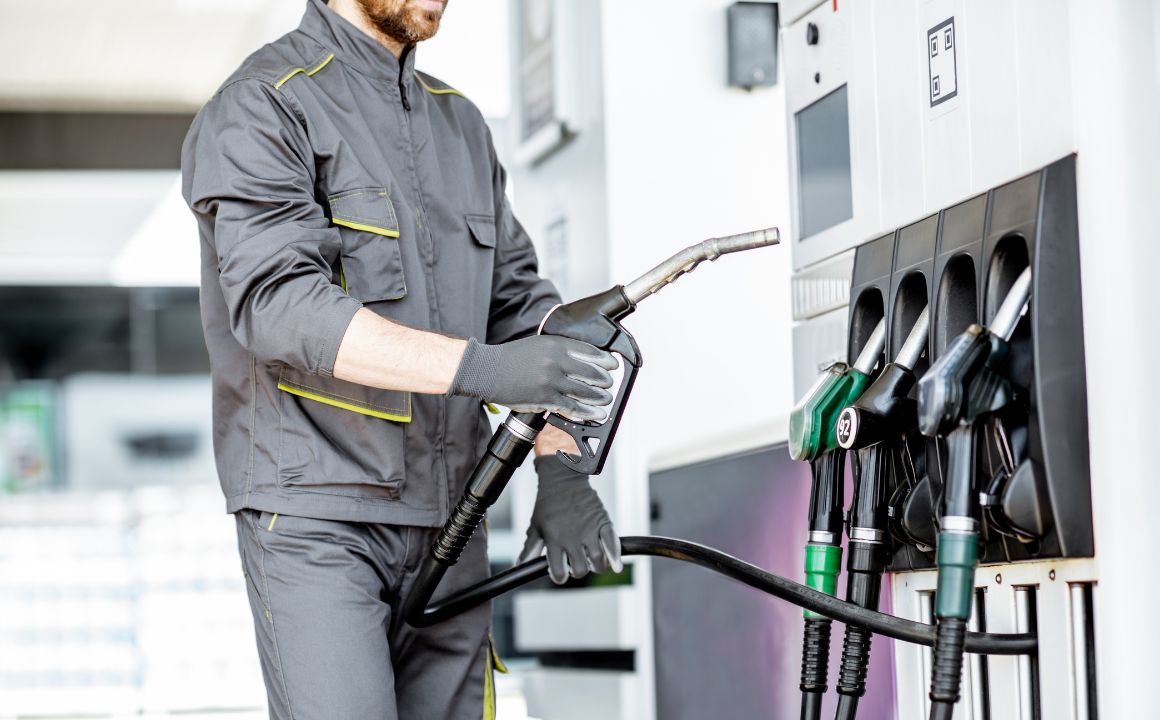
The prices at the pumps have been higher than ever recently. In fact, US gas prices were the highest they’ve ever been which has many people wondering why they’re high and if the prices will go down. Some are also wondering how it’s made. In reality, the two go hand-in-hand.  


Gasoline is made from crude oil (also known as petroleum). Crude oil (or petroleum) is a fossil fuel which means it is produced from the remains of plants and animals. These plants and animals lived millions of years ago and are covered by sediment which when exposed to weather, erosion, and other environmental factors, produces hydrocarbons.


Hydrocarbons can be liquid or gas. In this case, due to high pressure levels, the hydrocarbons formed under the ground are liquid hydrocarbons. These liquid hydrocarbons are what we know as crude oil (or petroleum). So, how does that become gasoline for vehicles? Let’s check it out!  

Step One 

When a crude oil source is found, drilling begins. Drills bore holes under the surface of the Earth in the area where crude oil has been found. Fun fact: these drills can go as far as one mile deep! The hole created by the drill acts as a well. With the addition of water into the soil, mud is created and this mud pushes cracked rock to the top of the hole at which point it is removed. This also ensures the crude oil stays below the surface. Once it has been determined the reservoir is ready for oil extraction, a pipe is inserted into the hole.  

Step Two  

This pipe is called a casing. This casing has holes in it that allow oil from the reservoir to enter the pipe and bring the oil to the surface of the Earth. Once recovered, the crude oil is stored in large tanks. From those tanks, oil is transported to a refinery via pipeline, ship, or tank cars on rail.  

Step Three 

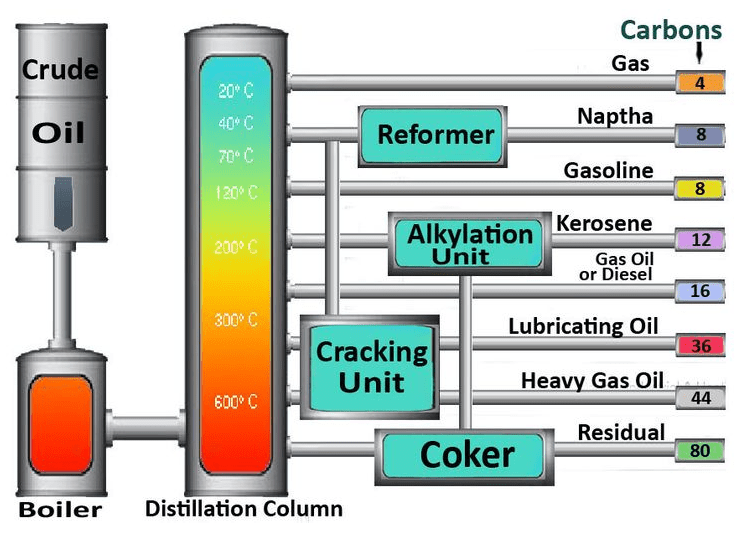
At the refinery, crude oil is broken down into a variety of other materials to include gasoline and diesel fuel. In fact, gasoline was discovered when crude oil was originally refined to produce oil and kerosene for lamps, prior to the invention of electricity. With the addition of heat (ranging from roughly 60 degrees Fahrenheit to 1100+ degrees Fahrenheit), crude oil is distilled. Distillation is where we create the various byproducts of crude oil. The byproducts made are dependent upon carbon atoms. Remember, crude oil consists of liquid hydrocarbons. Hydrocarbons consist of carbon atoms that link together. These links of carbon atoms can vary in length and depending upon the length, will have different properties, characteristics, or behaviors. 


Examples of these chains: a chain with one carbon atom is known as methane. Kerosene consists of 12-15 atom atoms in one chain. The more atoms in one chain, the heavier the byproduct. 

Oil Distillation Process

Step Four 

Once distilled, the byproducts require further refining. Additional refining processes include catalytic cracking, coking, reforming, and alkylation. These are all fancy words that describe the different ways in which the crude oil coming out of the distillation column is further refined and purified. Once finished, it is sent to refinery storage tanks.  

Step Five  

This step is all about blending. From the refinery storage tanks, gasoline is sent to smaller blending tanks via tanker, barge, or pipeline. Here, gasoline is typically blended with ethanol. Blending is done to create different grades of gas. Remember, when you pull up to the pump at a gas station, you see a variety of options. Diesel, E87, E88, etc. These are the grades of gasoline. Different grades of gasoline are made to meet different performance requirements of a vehicle. An example of this is gasoline produced for use in the winter. To improve a vehicle’s ability to start with a cold engine, gasoline is blended to a consistency in which it will vaporize more easily

Step Six 

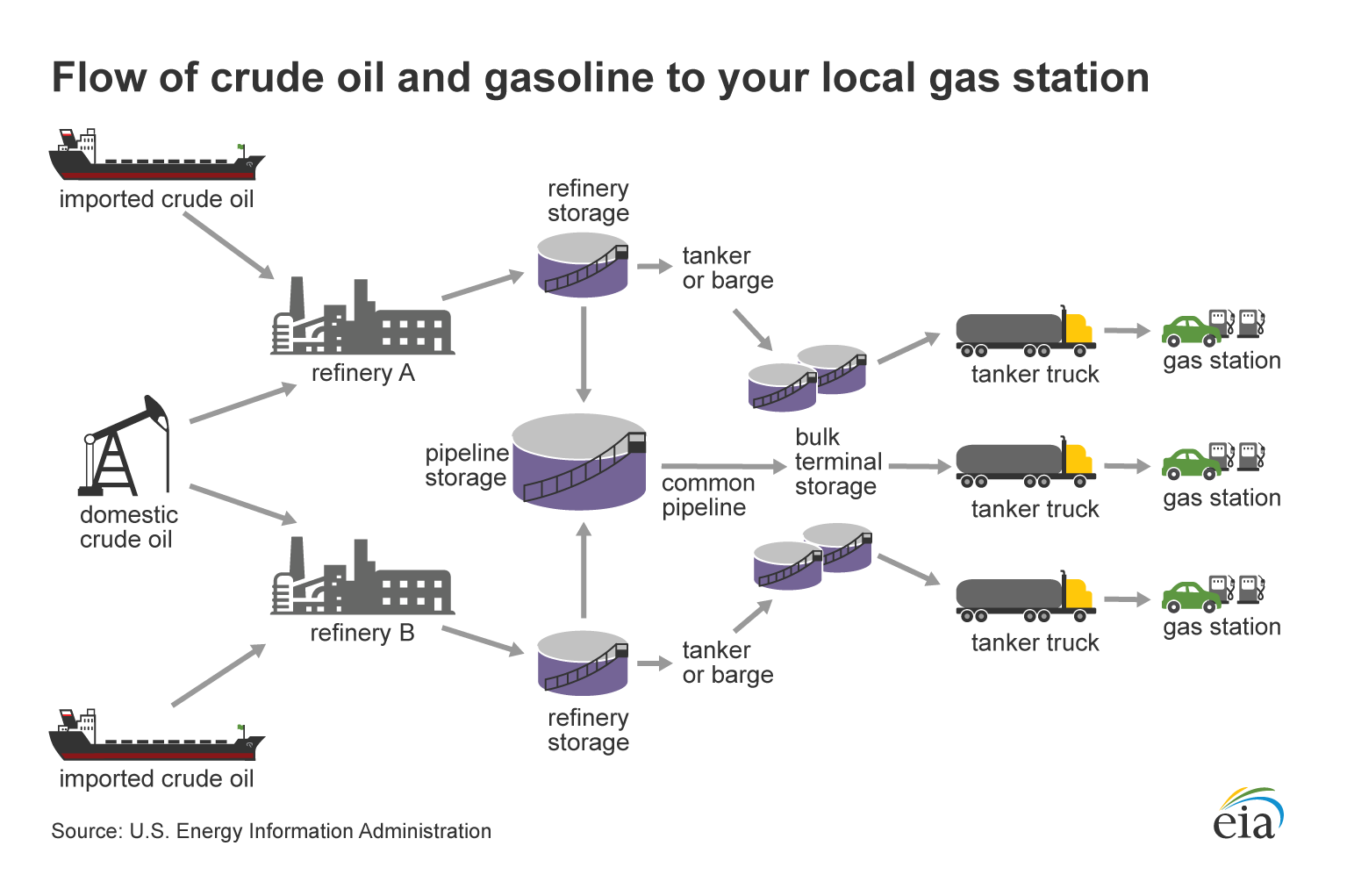
Once blended and ready for use, tanker trucks deliver the finished fuel to a gas station. The gasoline is stored in tanks underground at each gas station and from these tanks, are pumped up and out of the gas pump once you start it up. If you’re interested in more about that process, check out this article from howstuffworks.com. 

Flow of Crude oil and Gasoline to your pump

So, how does this all tie into the cost of gasoline prices? Well, it comes down to supply and demand. If supply is low but demand is high, prices are higher too. Therefore, if we are not drilling (onshore or offshore) for crude oil or if we are not receiving imported crude oil, we are not refining. If we aren’t refining, the supply is low while demand stays the same or increases. Of course, drilling is a hot button topic and when it comes to importing, supply chain and geopolitical events (which we’ve recently seen) will decrease supply. Thus, gasoline prices and gasoline production go hand-in-hand.

I’m sure you’re well aware of the tiny but iconic lollipops called Dum Dums. You might even have a favorite flavor — maybe even the elusive “Mystery Flavor”. But what exactly is it? Let’s break it down in this edition of How It’s Made.

How Is Candy Made?

Candy-making starts with two basic ingredients: sugar and water. From there, the type of candy determines additional ingredients — brown sugar, corn syrup, fats, acids, and flavorings all come into play.

Once mixed, the base is heated — sometimes up to 350 degrees Fahrenheit. Hard candies are heated at higher temperatures, while soft candies require less heat. After that, the mixture moves through a series of automated processes: molding, cooling, wrapping, and packaging.

These processes often use the same types of machinery found in hygiene product manufacturing.

In short: mix, heat, form, cool, and package. But that still doesn’t answer the big question…

Where Does the “Mystery Flavor” Come From?

The “Mystery Flavor” is actually the overlap between two batches of candy flavors.

To save time and reduce costly production downtime, manufacturers like Dum Dums avoid stopping the production line between flavor changes. Instead, they allow the end of one batch (say, strawberry) to blend into the beginning of the next (vanilla). That mix — strawberry-vanilla — becomes the Mystery Flavor.

There are so few candies made during that transition that it doesn’t make sense to give them a custom wrapper or name. Instead, they’re bundled under the mystery label. This keeps costs low and production high while offering a little extra fun for the consumer.

Now, consider this: Dum Dums currently offer 16 standard flavors. That means there are 256 possible combinations of two-flavor overlaps. So the next time you unwrap a Mystery Flavor, try to guess the mix — but don’t be surprised if it keeps you guessing. 

Spring has officially arrived.

The grass is green again. The birds are chirping. And maybe, just maybe, you’re thinking about that long list of home projects that didn’t get done last fall. But before you pick up the power washer or fire up the lawnmower, take a closer look around you. Odds are, you’ll find a different kind of spring hiding in plain sight.

Not the season. The metal kind.

Springs are everywhere. Inside your household cleaners. Beneath your mower deck. Behind your garage door. They’re small, tightly wound, often overlooked—and absolutely essential.

So, in this edition of “How It’s Made” with FlexTrades, we’re talking about the mechanics, materials, and manufacturing behind the humble spring.

Types of Springs

Springs come in two basic types—stretched and coiled.

  • Stretched springs store energy when pulled, like the tension in a bow and arrow. Pull back the string, and the spring (the bow) transfers energy to the arrow in a snap.
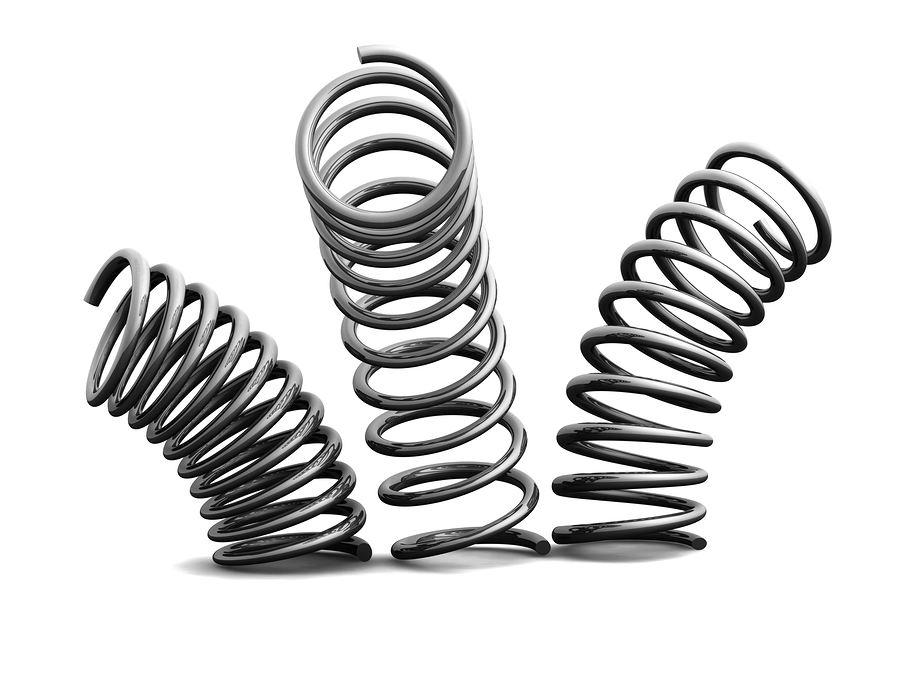
  • Coiled springs are the most common. They compress and expand to absorb shock, maintain pressure, or return components to a resting state. The first patent for a coiled spring dates back to 1763. The design has endured for a reason.

How Springs Are Made

No matter the style, the spring manufacturing process is surprisingly precise—and it all starts with the right material.

Materials

Springs are made from a wide range of materials based on end-use needs:

  • Stainless steel
  • Non-ferrous alloys like Monel
  • High-temperature alloys such as Inconel
  • High-carbon and alloy steels
  • Plastics (for specialty applications)

Design

Every spring is engineered with precision. The design process involves a surprising amount of math—factors like diameter, length, wire thickness, number of coils, and the amount of force needed are all carefully calculated to match the demands of the application.

Coiling

Once the specs are locked in, it’s time to wind. Coiling machines shape the material using either:

  • Cold winding for most wire types
  • Hot winding for thicker wire or bar stock

Not sure how a spring coiler works? Check out Automated Industrial Motion—they break it down with incredible detail.

Tempering

Tempering strengthens the spring and removes stress left over from the coiling process. Springs are exposed to extremely high temperatures for a set amount of time. The result? Better performance and durability under load.

Finishing

From grinding to coating, the final steps are all about getting the spring ready for real-world use.

  • Grinding flattens the ends of the wire
  • Shot peening smooths the surface and prepares for coating
  • Setting ensures the spring holds its shape under stress
  • Coating protects against corrosion
  • Quality control checks for exact performance specs

If you want to see the process in action, here’s a great visual to walk you through it.

Final Thoughts

Springs aren’t just for trampolines. They’re everywhere. And understanding how they’re made? That’s just one more way we at FlexTrades celebrate the people and processes that keep manufacturing moving.