
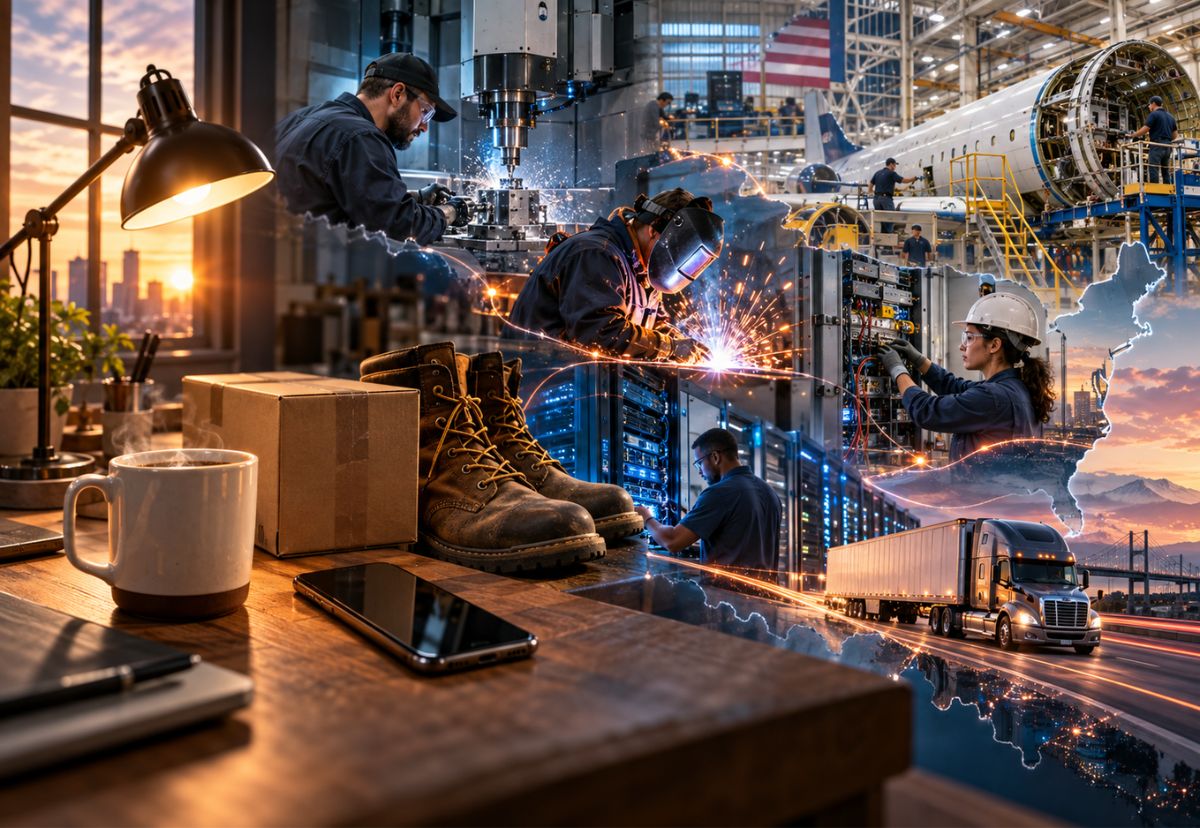
Manufacturing Day came and went.

Maybe you noticed. Maybe you didn’t.

Either way, take a look around wherever you are right now.

Your phone. Your desk. Your coffee cup. Your shoes. The lights above you. The chair you’re sitting in.

Now try to find something manufacturing didn’t touch.

I’ll wait.

It sounds easy until you actually start thinking about it.

Take the coffee cup.

Someone manufactured the cup. That part is obvious.

But someone also manufactured the equipment used to make it. The packaging it came in. The machinery that moved it through production. The truck that hauled it to a distribution center. The shelving it sat on before you bought it.

Go far enough down the line and one ordinary coffee cup turns into a massive network of machines, materials, parts, people and processes.

The same thing happens with almost everything around us.

Your phone is packed with manufactured components. Your office chair is built from fabricated metal, molded plastic, foam, fasteners and hardware. The building you’re sitting in depends on electrical systems, HVAC equipment, structural steel, wiring, piping, fixtures, tools and countless other products that had to be made somewhere.

Even the things we rarely associate with manufacturing depend on it.

Hospitals need medical equipment. Airlines need aircraft. Data centers need servers, cooling systems and electrical infrastructure. Farms need machinery. Restaurants need ovens, refrigeration systems and food processing equipment.

Manufacturing is everywhere.

Most of the time, we just don’t notice it.

That may be one of the more interesting things about the industry. The finished product gets the attention. The work behind it usually doesn’t.

We see the airplane. We don’t see the machinists who produced critical components.

We see the building. We don’t see the people who fabricated the steel, assembled the electrical systems or built the equipment used to construct it.

We see the package arrive at our front door. We rarely think about the machines, conveyors, trucks, tools and technology required to get it there.

And behind all of those things are people.

Machinists. Welders. Electricians. Technicians. Mechanics. Assemblers. Engineers. Quality professionals. Maintenance teams.

People who know how to build things, fix things, inspect things and keep production moving.

That part matters.

Technology continues to change manufacturing. Automation is getting smarter. Equipment is becoming more advanced. Production environments are more connected than ever.

But none of that eliminates the need for skilled people.

It makes them more important.

Manufacturing Day was created, in part, to help people see this industry differently. To look beyond outdated ideas about what manufacturing is and understand what it has become.

The day itself may have passed.

The point of it shouldn’t.

So take another look around.

Your phone. Your coffee cup. Your desk. The lights above you. The building around you.

Manufacturing helped put all of it there.

Maybe the most remarkable thing about manufacturing is how easy it is to forget just how much of our world depends on it.

Each year, we eagerly anticipate the arrival of Manufacturing Day (MFG Day), which takes place on the first Friday of October. Often, this celebration extends throughout the entire month, highlighting the significance of the manufacturing industry.

What is Manufacturing Day?

The inception of Manufacturing Day dates back to 2012 when the Fabricators and Manufacturers’ Association (FMA) joined hands with leaders from the National Institute of Standards and Technology Manufacturing Extension Partnership (NIST MEP). The brainchild behind this initiative was Ed Youdell, the President & CEO of FMA. Beginning as a modest concept, they conducted a pilot effort in the Midwest on the first Friday of October in 2012. As the years went by, the success of this day prompted them to collaborate with the National Association of Manufacturing (NAM) in 2016, who took the helm of the initiative. Thanks to NAM’s extensive network through The Manufacturing Institute, the event flourished. In just seven years, it expanded from around 240 events primarily in the Midwest to encompass more than 325,000 students, teachers, and parents participating in over 3,000 events across all 50 states and Puerto Rico.

How Can You Celebrate Manufacturing Day?

For Manufacturers:

  • Conduct Manufacturing Tours: Organize manufacturing tours within your facility. These tours can be in-person or virtual, making them accessible to individuals of all ages.
  • Educational Fair or Expo: Collaborate with other manufacturers in your area to host an educational fair or expo. Create informative displays, offer hands-on activities or demonstrations, and promote the event with giveaways.
  • Engage with Local Schools: Reach out to local schools, whether they are elementary, middle, high school, or technical colleges. Deliver presentations on the advantages of a career in manufacturing, highlighting earning opportunities, advancement prospects, and more. Foster enthusiasm among students.
  • Employee Appreciation: Celebrate your dedicated workforce. Show your gratitude by providing donuts, a pizza lunch, or a cookout for your employees. Express your thanks through cards, gift cards, or small tokens that convey your appreciation.
  • Social Media Acknowledgment: Share your appreciation on social media. Celebrate the manufacturing industry and your workforce with a heartfelt message of gratitude for their daily contributions that drive American manufacturing forward.

For Individuals:

  • Attend Manufacturing Tours: Attend manufacturing tours in your local area, whether in-person or virtual. These tours provide a valuable glimpse into the world of manufacturing.
  • Job Exploration: Approach your employer and inquire about participating in Manufacturing Day activities. Explore different areas of your workplace and spend the day learning about roles you may not have encountered before.
  • Educational Videos: Watch informative “How It Works” videos related to manufacturing processes. Share your favorite videos with friends and colleagues to spread awareness.
  • Engage the Next Generation: If you have children in your life, engage in meaningful conversations about manufacturing while enjoying ice cream. Show them videos and emphasize that it offers a viable career path with substantial earning potential and room for growth.
  • Educational Games: Introduce youngsters to educational games like the Manufacturing Institute’s Smart MFG 2 App, where kids can design and manufacture a drone. Additionally, consider playing board games like “The Manufacturing Game.” You can also explore a variety of factory simulation games.

There are numerous ways to celebrate Manufacturing Day, and the ones mentioned here are just a few examples. As you celebrate the manufacturing industry, its dedicated professionals, and those working tirelessly to drive it forward, remember that you can promote and celebrate it not only on one designated day but throughout the entire year!