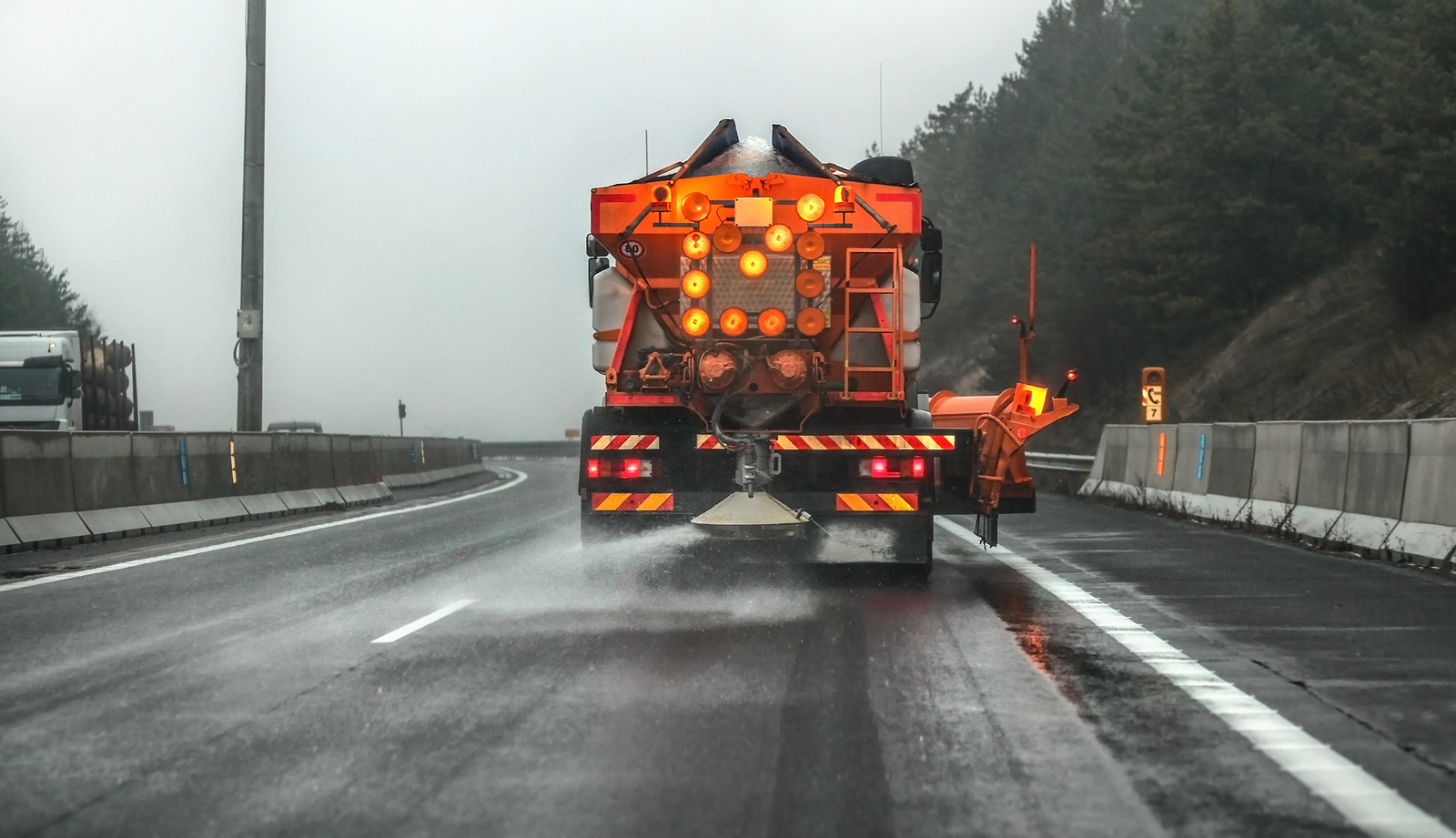
Spring brings warmer weather, melting snow, and… slippery roads. As ice and frost linger on highways and sidewalks, salt trucks hit the streets to keep drivers safe. But have you ever wondered where all that road salt comes from—and what impact it has?

Where Does Road Salt Come From?

The main ingredient in road salt is sodium chloride, the same compound found in table salt. Mines in Ohio, Michigan, New York, Kansas, and Louisiana produce nearly 90% of the salt used on U.S. roads. It’s the most effective and widely used deicing method, but it comes with some serious downsides.

The Environmental & Vehicle Impact of Road Salt

As winter fades and spring arrives, road salt doesn’t just disappear. It runs off into streams, lakes, and rivers, disrupting plant and animal life. Too much salt in these ecosystems can damage habitats and even cause long-term environmental harm.

Salt also accelerates vehicle corrosion. If not washed off regularly, it can eat away at metal components, leading to expensive repairs.

Sand: A Safer, Cheaper Alternative?

Because of these concerns, many states supplement or replace salt with sand. Unlike salt, sand doesn’t melt ice, but it improves traction and helps vehicles maintain control on slick surfaces. It’s also about 75% cheaper and less harmful to the environment.

Stay Safe on the Road

No matter what deicing method is used, icy roads remain a seasonal hazard. Keep an eye out for salt and sand trucks, drive cautiously, and be aware of changing conditions.

Want to learn which states use the most salt and sand? Check out these resources:

🔗 State-by-State Salt & Sand Usage
🔗 Salt Belt & Vehicle Corrosion Risks 

Women Who Have Shaped and Continue to Shape Manufacturing

March is Women’s History Month, a time to recognize and celebrate the contributions of women across industries—including manufacturing. Women have been integral to the evolution of this field, from the Industrial Revolution to the modern era of Industry 4.0.

At FlexTrades, we believe in honoring the trailblazers who paved the way while also recognizing the women shaping the future of manufacturing today. Here are three historical figures who left a lasting impact on the industry—plus one woman actively working to empower and unite women in manufacturing today.

Rosie the Riveter: The Icon of Women in Manufacturing

Few symbols are as powerful as Rosie the Riveter. During World War II, the U.S. government launched a campaign to encourage women to take on factory jobs while men were at war. Rosie became the face of that movement.

But over time, Rosie came to represent far more than wartime labor. She became a symbol of empowerment, resilience, and the role of women in manufacturing, proving that women could not only step into traditionally male-dominated roles but also excel in them.

Stephanie Kwolek: The Accidental Innovator Who Revolutionized Safety

Unlike Rosie, Stephanie Kwolek wasn’t a household name—but her impact on manufacturing and safety is undeniable.

Originally aspiring to be a doctor, she took a temporary job at DuPont to save money for medical school. That temporary job turned into a 40-year career, during which she discovered Kevlar—one of the most durable and widely used industrial fibers in the world.

Kevlar is used in boats, airplanes, parachute lines, and ropes, but its most famous application is bulletproof vests, which have saved countless lives.

Fun Fact: Stephanie discovered Kevlar while researching a lighter, stronger alternative to steel for use in tires. What she created was five times stronger than steel, heat-resistant, and more flexible than fiberglass.

Ella May Wiggins: The Voice of Women in the Workforce

During the Industrial Revolution, women made up 75% of the textile mill workforce. Among them was Ella May Wiggins, a single mother of five working as a spinner in a textile mill.

But Ella May was more than just a worker—she was a fierce advocate for labor rights. She fought for fair wages, better working conditions, and support for working mothers. She participated in one of the most famous textile mill strikes and even wrote protest ballads condemning the industry’s mistreatment of workers.

Her song “Mill Mother’s Lament” remains a powerful testament to the struggles of early female workers in manufacturing.

Allison Grealis: Leading the Future of Women in Manufacturing

While Rosie, Stephanie, and Ella May paved the way, Allison Grealis is actively shaping the future.

As the Founder and President of Women in Manufacturing (WiM), she leads a nationwide trade association dedicated to supporting, promoting, and advancing women in the industry.

What started as a small networking group within the Precision Metalforming Association has grown into a powerful independent organization, providing resources, mentorship, and opportunities for women in manufacturing.

Women Will Shape the Future of Manufacturing

These four women represent just a fraction of the contributions women have made to manufacturing. Today, as the industry evolves with #Industry40 and works to bridge #TheSkillsGap, the role of women is more critical than ever.

At FlexTrades, we celebrate the past, present, and future of women in manufacturing. As opportunities continue to expand, the next generation of leaders, innovators, and trailblazers is just getting started.

Want to learn more about careers in manufacturing? Explore opportunities with FlexTrades today.

It’s no secret that manufacturing has an image problem that is preventing younger generations from not only pursuing, but even considering a career in manufacturing. At times, it can be an uphill battle to get the current generation to see the opportunities available to them. With Father’s Day right around the corner, I thought now would be a perfect time to address some of these myths and misconceptions and shine some light on manufacturing truths.

Watch our webinar Myths & Misconceptions in Manufacturing to learn more!

Jobs in Manufacturing are unsafe

Safety ratings for careers in this industry improved throughout the last century and that focus and improvement will continue throughout the next for several reasons:

  • Unsafe factories are unprofitable factories and profit drives improvement.
  • OSHA, MSHA, and other regulatory bodies. There is a greater focus, and enforcement, placed on safety in the workplace than ever before and it shows.
  • Robots aren’t going to take your jobs but they are already taking the dangerous ones.

Jobs in Manufacturing are dirty

Dirty Jobs is a TV show, not the reality of American production facilities.

  • The focus on safety from within the industry and governmental bodies naturally leads to a cleaner workplace. Clean factories are safe factories.
  • Modern production methods and materials often require clean room type environments by necessity.
  • The realities of modern hiring often require a clean environment to show. Everyone has to keep up with the Jones in the fight for new talent – even manufacturers.

Jobs in Manufacturing are low-skill, low-paying, and boring

Hello, have you heard of the Skills Gap? Its very existence refutes the unskilled point.

  • High skill equals high pay. This sector is seeing growth in demand AND wages and we have the skills gap to thank for that.
  • There is no industry where you are more likely to receive on the job training or continuing education opportunities from your employer than this one. Workforce reinvestment is a continuous driver of both wage and skill growth.
  • Remember robots? Their presence in the industry may be making our jobs safer and physically easier, but they are doing that primarily by replacing the LOW skilled jobs. This means, the positions requiring higher skill sets make up a disproportionately higher percentage of all sector jobs than they did in previous generations where automation was less prevalent.

Jobs in Manufacturing are unfriendly to female and minority employees

To put it plainly, manufacturing is still an industry dominated in America by white males, but that is changing.

  • 29 percent of women in 2017 (compared to 12 percent in 2015) think the school system actively/somewhat encourages female students to pursue a career in the manufacturing industry.
  • 42 percent of women in 2017 (compared to 24 percent in 2015) are now ready to encourage their daughter or female family member to pursue a career in their industry.
  • More than half of women (58 percent) have observed some positive changes in their industry’s attitude towards female professional employees, over the last five years.
  • Minority representation in the workforce has doubled since 1980 (from 18% to almost 40%) and Hispanic/Latino representation specifically has nearly tripled during that same time period.

Robots are going to take all the jobs

Robots will not take away all positions in manufacturing, but the ever-increasing prevalence of automation, IoT, predictive analytics, additive manufacturing, virtual/augmented/mixed reality, will change them consistently and continuously throughout your career by making those jobs

  • Safer
  • More Productive
  • More Interesting
  • Higher Paying

To learn more about the impact technology will have on manufacturing, check out our webinar Manufacturing in the future: the changes yet to come.  

Soft skills matter. In fact, in today’s professional landscape—especially in technical trades—they’re more critical than ever.

Yet, one common challenge remains: many new professionals enter the workforce without strong soft skills, particularly in time management, networking, and industry awareness.

So, how can you change that? How can we change that?

The answer is simple—take on the 30-Day LinkedIn Challenge.

The Challenge

It only takes 10 minutes a day, and it checks three key boxes for career growth. Here’s how:

Step 1: Arrive 10 Minutes Early

Get to your destination 10 minutes before you need to. Every. Single. Day.

Step 2: Add Three New LinkedIn Connections

Use those 10 minutes to build your professional network:

  • One person you know personally
  • One person in your industry or the field you want to enter
  • One person from a completely different industry

For example: If you’re a welding student, connect with your instructor, a local Miller welding rep, and—why not—someone like Warren Buffett.

This step takes less than three minutes but expands your network exponentially.

Step 3: Learn Something New

Use the remaining time to scroll your LinkedIn feed and absorb one piece of information relevant to your career.

That’s it. Simple, right? But the impact? Huge.

Why This Matters

The 30-Day LinkedIn Challenge tackles three key workplace gaps:

  1. Time Management & Punctuality – Being early sets you apart. It builds discipline. It shows initiative.
  2. Industry Awareness – Many new professionals enter the workforce with technical skills but little understanding of the broader industry.
  3. Professional Support Networks – Success isn’t just about what you know—it’s about who you know.

The Impact

By committing to this challenge, you will:

  • Learn how to maximize small moments for growth
  • Take ownership of your personal development
  • Shift from just being a skilled tradesperson to becoming a student of your craft
  • Develop the same networking advantages that professionals in other industries rely on daily
  • Strengthen a continuous improvement mindset

Ready to Start?

If you’re serious about improving your professional outlook—whether in manufacturing, engineering, or any skilled trade—start with the 30-Day LinkedIn Challenge today.

Begin with these three connections:

After 30 days, if you think this challenge was a waste of time, let us know. But we bet you’ll see the difference.