“Job-ready on day one.”

It’s a phrase that sounds simple. But in manufacturing, simple phrases can carry complicated expectations. Let’s clarify what job-ready really means for American manufacturers, in-house hires, and skilled trades staffing partners alike.

When we tell clients our technicians will arrive job-ready on day one, we’re not saying they’ll walk into a brand new facility and operate independently within the first hour on-site. That wouldn’t be realistic, and unrealistic expectations don’t serve anyone.

Every manufacturing environment is different. Your processes are unique. Your equipment is configured your way. Your quality systems, ERP workflows, and internal communication rhythms are yours alone. Even the most experienced technician still needs orientation to your operation.

That’s not a weakness. That’s manufacturing reality.

Job-Ready Means Skilled, Experienced, and Prepared

When we say job-ready, we mean a technician arrives with:

  • The skills and experience required for success in the role
  • Hands-on familiarity with relevant tools, equipment, and systems
  • The ability to read prints, schematics, and technical documentation
  • A strong safety foundation and understanding of PPE expectations
  • Professionalism and the ability to integrate into an existing team

They are not learning their trade on your floor. They are applying a trade they already know.

That’s a meaningful difference.

What Job-Ready Does Not Mean

Job-ready does not mean zero ramp-up required.

No skilled trades professional, regardless of background, can skip site-specific onboarding. Your workflows, approval processes, quality checks, and internal standards still need to be learned.

The goal isn’t to eliminate ramp-up. The goal is to shorten it. And that’s the expectation we set clearly with our clients.

The Real Expectation: Rapid Ramp-Up

What we communicate, and what we see consistently play out, is this:

Our technicians ramp up rapidly, generally within a week or two for most technicians on most projects. That timeline isn’t about guarantees. It’s about patterns.

When someone already has the technical depth, industry exposure, and professional maturity required, they don’t need months to become productive. They need context.

Once they understand your environment, they execute.

Some of our clients are deeply aware of how unique their operations are compared to the “typical manufacturer”. They know no outside technician will be fully autonomous on day one. What they value is bringing in professionals who are capable of accelerating quickly, much faster than other gap-bridging options.

That’s where the difference shows.

Why This Clarity Matters

When expectations are vague, frustration builds.

If “job-ready” is interpreted as “independent immediately,” supervisors can feel disappointed. Technicians can feel pressure that isn’t safe or realistic. Projects can stall unnecessarily.

When expectations are aligned, something different happens:

  • Supervisors provide focused, site-specific onboarding.
  • Technicians absorb information efficiently.
  • Teams collaborate during that first critical week.
  • Productivity builds steadily instead of stalling.

A short ramp period, when handled intentionally, protects safety and quality while still meeting production goals.

The Difference Between Headcount and Capability

Manufacturers don’t need extra bodies. They need capable professionals who can step in, understand the assignment, and contribute quickly.

Job-ready on day one means:

  • You’re not teaching trade fundamentals.
  • You’re not correcting basic technical gaps.
  • You’re not absorbing avoidable safety risk.

You’re onboarding an experienced professional and skilled technician who understands manufacturing environments and can adapt to yours.

That adaptability is what drives rapid ramp-up.

Why It Matters Right Now

Production timelines are tight. Skilled labor is limited. Projects don’t wait.

But rushing someone into full independence before they understand your systems isn’t efficient, it’s risky.

The strongest partnerships are built on balanced expectations:

  • We send technicians ready to work.
  • You provide the site-specific onboarding that every company requires.
  • Together, we support a rapid ramp-up – typically within a week or two for most technicians on most projects.

That alignment protects productivity without compromising safety or quality.

The Bottom Line

Job-ready on day one doesn’t mean independent on day one.

It means skilled. Prepared. Professional. And capable of ramping up rapidly in a new environment.

Every manufacturing operation is different. We respect that. Our role isn’t to pretend onboarding isn’t necessary. Our role is to provide technicians who can move through that onboarding efficiently and reach full productivity quickly, safely, and successfully.

That’s what job-ready really means. Not instant. Accelerated.
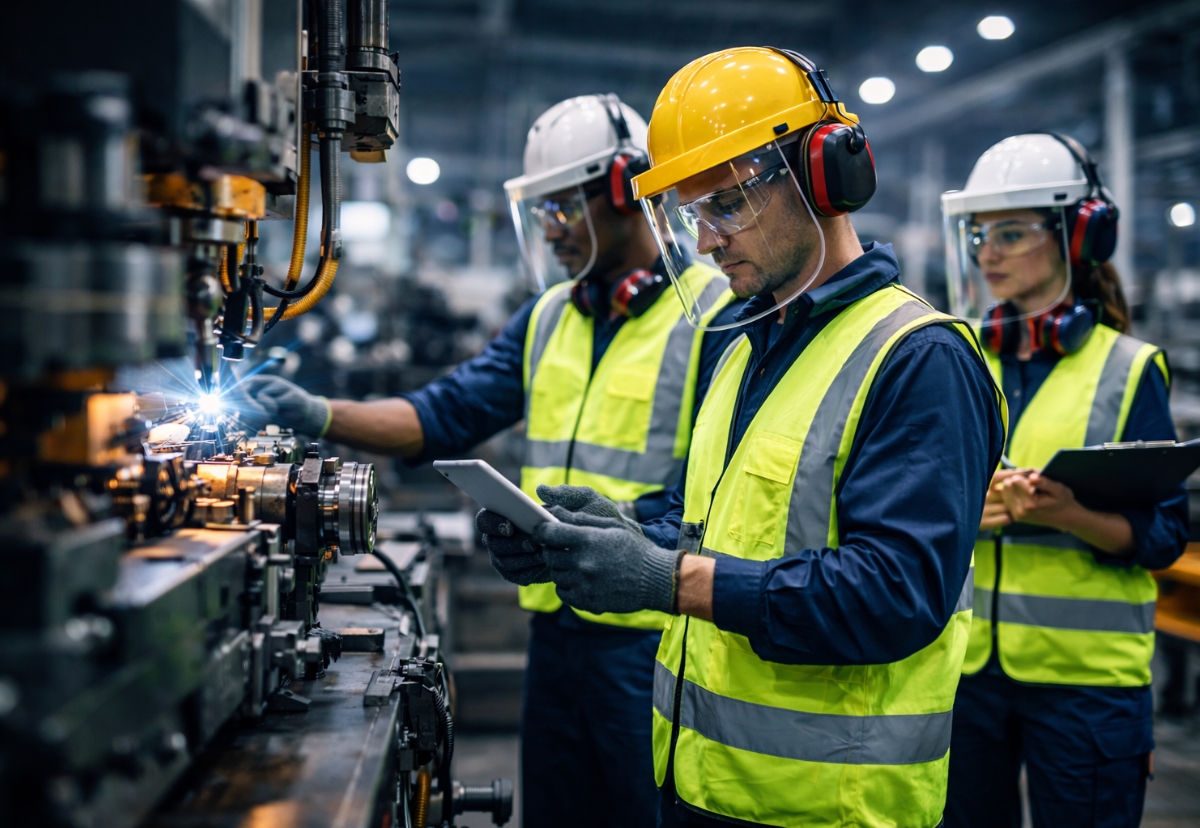
For manufacturers, PPE compliance is not just about avoiding citations. It is about operational stability.

Safety Is a Shared Responsibility

When you partner with a workforce solutions company or staffing firm, you do not outsource safety. OSHA makes that clear. The host employer is responsible for identifying workplace hazards and communicating site-specific PPE requirements. The staffing firm is responsible for ensuring workers are properly trained and prepared. Understanding this division of responsibility is critical because alignment upfront prevents confusion once work begins.

Clear Expectations Reduce Risk and Cost

Inconsistent PPE policies create gray areas. Gray areas create injuries. Injuries create downtime, claims, and potential liability. Clarity is essential to maintaining a safe and productive partnership.

Clear, documented PPE requirements:

  • Reduce recordable incidents
  • Limit workers’ compensation exposure
  • Help protect your Experience Modification Rate (EMR)
  • Strengthen audit readiness

Strong Safety Partnerships Drive Productivity

The safest facilities are often the most efficient. When expectations are clear and consistently enforced, work moves faster because people trust the systems around them.

Job-ready on day one is not just about skill. It is about being properly equipped.

Why PPE Matters to Skilled Trades Professionals

For technicians, especially those entering a new facility, PPE provides immediate protection in an unfamiliar environment.

Contract and temporary workers can face higher risk because they are:

  • New to the site
  • Less familiar with specific hazards
  • Operating within compressed onboarding timelines

Proper PPE:

  • Reduces exposure during that critical first shift
  • Reinforces that safety is a priority
  • Encourages awareness and proactive hazard reporting

When a technician sees that both their employer and the host facility take PPE seriously, it builds trust. Trust leads to stronger performance.

The Most Overlooked Factor: Communication

From a safety professional’s perspective, most PPE failures do not happen because someone lacks safety glasses. They happen because expectations were not aligned from the beginning.

Successful PPE programs depend on three things:

  • Clear Hazard Identification: Clients must define site-specific risks before a technician arrives.
  • Pre-Assignment Communication: Staffing partners need detailed PPE requirements in advance, beyond “steel-toe boots required.”
  • Consistent Enforcement Onsite: If rules are not consistently enforced, compliance erodes quickly.

When these three elements align, PPE functions as intended.

PPE Is Culture, Not Just Equipment

Anyone can purchase gloves or face shields. Not every organization builds a culture where they are consistently worn and respected.

A strong PPE culture includes:

  • Supervisors modeling compliance
  • Immediate correction of unsafe behavior
  • Open reporting of hazards
  • Continuous review of changing job risks

It also requires partnership.

Workforce partners rely on clients to provide accurate hazard assessments and enforce site rules. Clients rely on staffing firms to prepare skilled trades professionals before arrival and reinforce expectations throughout the assignment. When both sides communicate openly and act quickly on concerns, everyone benefits.

The Bottom Line

PPE works best when it is treated as essential, not optional.

It protects technicians stepping into new environments. It protects manufacturers from costly incidents and compliance gaps. It protects partnerships built on trust.

Manufacturing is demanding. Skilled trades work is hands-on, high-impact, and often high-risk. The right PPE, clearly communicated and consistently enforced, is one of the simplest and most effective ways to protect the people who keep production moving.

Safety is not just a staffing issue. It is not just a client issue. It is a shared responsibility.

And when PPE is done right together, everyone benefits.

Engineering is the discipline of making things work. From the skyscrapers shaping city skylines to the microchips powering smartphones, engineering touches nearly every part of modern life. While the profession is grounded in universal principles such as applying scientific and mathematical concepts to solve real problems, each sector applies those principles differently. One of the most diverse and essential branches of engineering operates within manufacturing.

What Unites Engineers Across Industries?

Despite their differences, engineers share a common purpose… to innovate, optimize, and solve problems. Across industries, they improve efficiency, ensure quality, and drive technological advancement. Key similarities include:

  • Problem Solving: Engineers analyze complex challenges and develop practical, scalable solutions.
  • Systems Thinking: They evaluate how individual components function within larger systems.
  • Optimization: Efficiency, safety, reliability, and performance remain top priorities.
  • Use of Technology: Modern engineering relies on advanced software, simulation tools, automation platforms, and data analytics.
  • Quality and Safety Compliance: Engineers must follow strict regulatory, safety, and industry standards.

What Makes Engineering in Manufacturing Unique?

While manufacturing engineering follows the same foundational principles as other disciplines, the environment presents distinct challenges.

Speed and Efficiency as Priorities

Civil or aerospace projects may take years to complete. Manufacturing operates on compressed timelines. Engineers must support rapid production cycles while minimizing downtime and maintaining consistent quality.

Continuous Improvement and Iteration

Unlike one-time design projects such as bridges or medical devices, manufacturing engineers operate in a constant state of refinement. They improve processes over time using structured methodologies such as Lean manufacturing and Six Sigma, both widely used in industrial operations to reduce waste and variation.

Integration of Automation and Robotics

Manufacturing environments depend heavily on automation. Engineers design, implement, and maintain robotic systems, programmable logic controllers, sensors, and smart equipment that improve productivity and reduce variability.

Material Selection and Process Engineering

Material selection in manufacturing must account for cost, availability, durability, regulatory requirements, and manufacturability at scale. Engineers evaluate tradeoffs between performance and production feasibility.

Workforce and Equipment Coordination

Manufacturing engineers balance human labor, robotics, and heavy machinery within complex production environments. They ensure workflows are synchronized and resources are allocated effectively.

Cost Driven Decision Making

Cost efficiency is central to manufacturing. Engineers must continuously identify ways to reduce scrap, shorten cycle times, improve yield, and control operating expenses without sacrificing safety or quality.

Types of Engineers in Manufacturing

Modern manufacturing relies on specialized engineering roles, including:

  • Manufacturing Engineer. Improves and standardizes production processes.
  • Design Engineer. Develops products optimized for manufacturability and performance.
  • Mechanical Engineer. Designs and maintains mechanical systems and equipment.
  • Electrical Engineer. Develops and supports electrical infrastructure and control systems.
  • Process Engineer. Optimizes workflows and production methods.
  • Industrial Engineer. Improves plant layouts, labor efficiency, and operational systems.
  • Production Engineer. Oversees daily manufacturing execution and output.
  • Quality Engineer. Implements quality systems aligned with industry standards.
  • Controls Engineer. Designs and programs automated control systems.
  • Test Engineer. Validates product reliability, safety, and performance.
  • Tooling Engineer. Designs custom tooling, fixtures, and production aids.
  • Applications Engineer. Works with clients to implement technical solutions for specific needs.
  • Materials Engineer. Selects and tests materials for strength, durability, and cost efficiency.
  • Robotics Engineer. Designs and integrates robotic systems.
  • Automation Engineer. Implements smart manufacturing technologies and connected systems.
  • Mechatronics Engineer. Combines mechanical, electrical, and software systems to build intelligent machinery.

The Future of Manufacturing Engineering

Manufacturing continues to evolve as technology advances.

  • Smart Factories and Industry 4.0: Connected manufacturing environments leverage industrial IoT, AI, and real-time data analytics to improve visibility, predictive maintenance, and decision making.
  • Sustainable Manufacturing: Engineers are developing energy efficient processes, waste reduction strategies, and environmentally responsible material alternatives.
  • Advanced Robotics and AI Integration: Autonomous systems are becoming more adaptive and data driven, improving flexibility across high mix, low volume production.
  • Space Manufacturing: With increased commercial investment in space, research is exploring manufacturing in microgravity environments, including additive manufacturing and material behavior beyond Earth conditions.

Looking for Engineering Solutions?

At FlexTrades, engineering is more than a discipline. It is the backbone of modern manufacturing performance. Whether you are a company seeking experienced engineers to strengthen production or an engineer looking for your next challenge, FlexTrades connects talent with opportunity.

Are you an engineer ready for a new assignment? Explore opportunities that let you apply your expertise across industries and projects nationwide.

Need engineering support for your manufacturing operations? Contact FlexTrades to access skilled engineering professionals who can improve efficiency, strengthen quality systems, and support production stability.

Let’s build the future of manufacturing together. Connect with FlexTrades today.

Every plant manager, operations leader, and HR executive we talk to in American manufacturing tells a variation of the same story: “We can’t find the skilled workers we need right here where we are.”

It’s not a seasonal blip. It’s structural.

The Manufacturing Skills Gap Isn’t Just Local. It’s National

Skilled trades shortages are more than just a recruiting headache. They’re a strategic challenge for American manufacturers. From CNC machinists and industrial electricians to maintenance techs and welders, demand is outpacing supply significantly. For example, aggregate data shows that American industries face millions of unfilled skilled trade openings annually, with an estimated 1.7 million-worker shortfall between job openings and qualified graduates every year.

That gap isn’t a local anomaly. It’s a national trend that affects manufacturing hubs and rural regions alike. Whether you’re in a highly populated metro area or a smaller community with a proud manufacturing tradition, the math is the same: there just aren’t enough qualified workers locally to meet current demand.

Why Local Labor Pools Alone Don’t Cut It

Here’s the hard reality:

  • Skilled trades programs and vocational pipelines have not kept pace with employer demand.
  • Many regions, especially outside major cities, lack the training infrastructure to produce workers with advanced, manufacturing-ready skills.
  • Even where local talent exists, retirements are outpacing new entrants into the workforce. Skilled trades workers in some fields are aging rapidly, and the inflow of new talent is insufficient to replace them.

This has real consequences. In some sectors, companies turn down work or delay projects because they simply cannot staff them even when demand is there and capacity exists.

The National Talent Advantage: Why Broader Labor Pools Matter

So, what’s the alternative? For innovative manufacturing leaders, the answer is clear. Don’t limit your talent strategy to the ZIP code your plant happens to be in.

A nationwide workforce model, like the one FlexTrades has built, unlocks access to talent that’s:

  • Pre-vetted and travel-ready, so assignments begin quickly
  • Diverse in skill and geography, reducing regional talent bottlenecks
  • Experienced across industries, bringing best practices and adaptability

In contrast to a purely local recruiting strategy, this approach allows manufacturers to tap into labor pools that aren’t constrained by geography or community demographics. This is vital when the local labor force can’t meet demand.

Real Business Impact: FlexTrades’ Nationwide Difference

We see this in action every day:

  • A facility in a rural Midwest town fills critical maintenance roles they couldn’t staff from local resumes alone.
  • A coastal plant scales up for a major production run by deploying skilled machinists from across multiple states.
  • A manufacturer accelerates uptime by bringing in welders and technicians from regions with stronger workforce pipelines, without draining local talent.

In each case, it’s not that the skills didn’t exist in the country. It’s that they weren’t accessible locally. A broader labor network solves that problem.

A Strategic Advantage in a Tight Labor Market

Manufacturing is at a crossroads. Investment in domestic production, from clean energy equipment to advanced electronics, is rising. But talent constraints threaten to slow progress.

Decision-makers need solutions that go beyond traditional recruiting: models that think nationally but act locally, delivering skilled talent where and when it’s needed. That’s how you keep production lines running, reduce downtime, and compete in today’s fast-moving global economy.

Because at the end of the day, not all labor pools are created equal, but the right one can make all the difference.