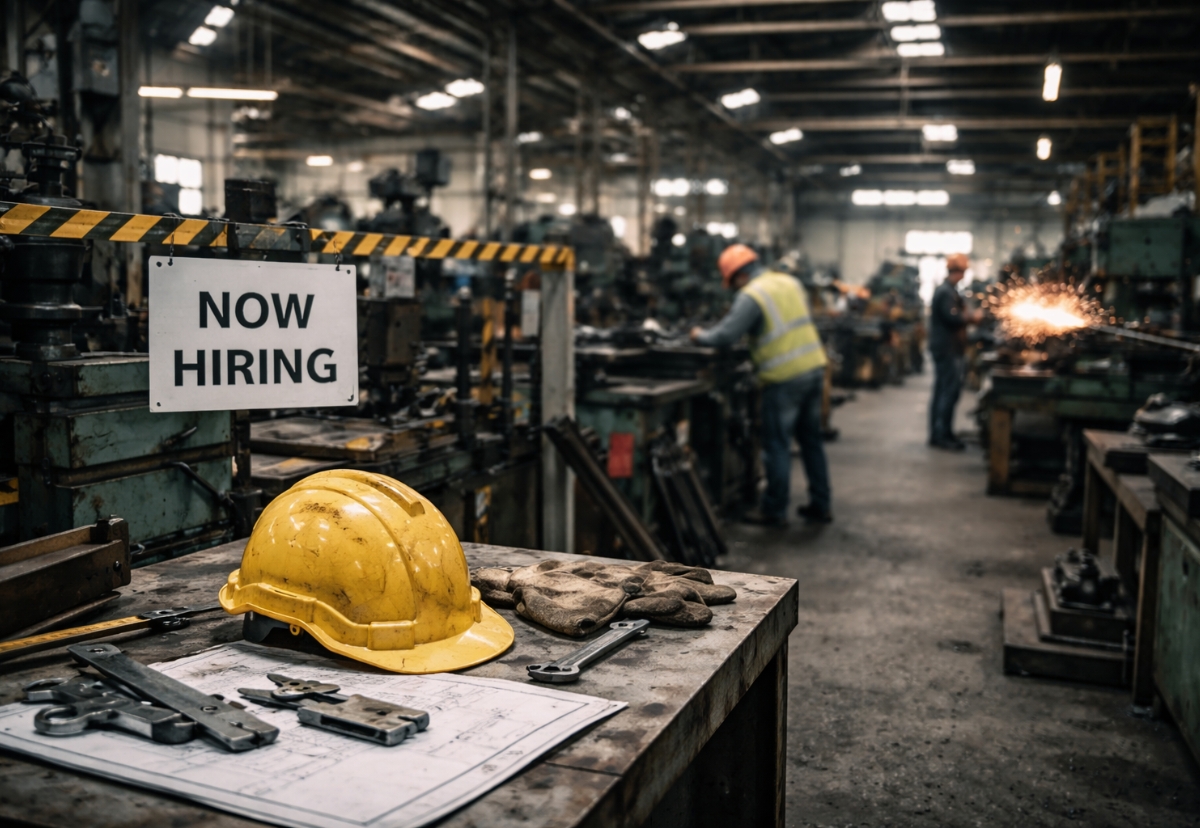
The skilled labor shortage in America is a growing problem that requires our immediate time and attention. It is a problem that was strengthened by COVID-19, the great resignation, and a myriad of other issues that we’ll discuss in a few minutes. But how bad is the skilled labor shortage, really, and what can a company like yours do to overcome it?
According to a study conducted in 2022 by the United States Bureau of Labor Statistics, nearly 8 million skilled trade jobs were lost in the United States during the COVID-19 pandemic, which spanned much of 2020, 2021 and 2022. In the time since, about half of those jobs have been filled, but what about the remaining 4 million vacancies that continue to mar industries like manufacturing, transportation, and construction? Is there any immediate or long-term relief in sight? The answers to those questions are… complicated, for lack of a better phrase. Let me explain.
No singular, defining reason for the skilled labor shortage can be given without serious scrutiny, and before we seek to fully understand what’s driving this complicated issue, we will first need to spend a few minutes looking deeper into the primary factors that are causing the problem.
Problem 1: There aren’t enough qualified candidates
COVID-19, the great resignation, the rise of remote work, a decline in apprenticeship programs, retiring baby boomers, the elimination of shop classes, stagnant wages, and dwindling enthusiasm for labor-intensive work among younger generations are all a part of the skilled labor shortage we face in the United States. This shortage, in turn, translates to fewer qualified applicants for every skilled labor career available right now. Too many jobs and not enough qualified workers, that’s the crux of the problem.
Problem 2: The false perception of skilled work
Fifty years ago, choosing a career in the skilled trades meant that you had a steady job, a decent paycheck, solid health benefits, and the means to be able to provide for yourself and for your family. But the great steel mill closings throughout much of the northeast from 1980 – 1988 were anything but kind to the perceptions we place on skilled labor careers.
For many born between the years of 1975 – 2005, a career in skilled labor is considered a “fallback career,” or rather a job you take only if you can’t find anything less labor intensive that suits you. This idea is completely ridiculous, and shame on our fathers for teaching us to believe that a four-year degree was always the better choice.
Many of today’s skilled labor careers offer excellent pay, benefits, job security and a clear-cut path to promotion and advancement. In fact, there are companies like FlexTrades that not only pay technicians well, they also offer the freedom to choose what assignment they take on and where… bridging the skills gap and offering flexibility to its employees at the same time.
FlexTrades offers an immediate, no-brainer-type of solution to the skilled labor shortages we face, so why aren’t more companies taking advantage of this model? That’s a great segway into problem number three.
Problem 3: Our fathers failed us and we, in turn, failed you
I am a journalist by trade who entered the marketing world shortly after the U.S. economy went belly up in 2008. And I hate to admit this because I’m partially to blame, but our parents, and other people in positions of influence and prestige, have failed skilled laborers.
We have failed you because our father’s failed to teach us that by bypassing a four-year degree you could study a skilled trade, graduate relatively debt free and have a promising career waiting for you after getting out of school.
We have failed you because we pushed the idea that getting a degree, landing a corporate job, and making a career outside of the skilled trades was the better choice.
We have failed you because we are the product of a liberal educational system that was never meant, or designed, for skilled tradespeople.
We have failed you because we did not create, educate, or promote insightful content about what it truly means to be a skilled laborer.
We have failed you because, at our very core, we are engrained to push the corporate agenda at all costs to keep profit margins up and expenses down.
That’s all on us… not you. It’s our collective bad, and I think it’s high time that we change the way people think about skilled trades.
Problem 4: Our educational system is broken
When I was growing up, I was taught that to land a good job and build a good life for myself that I needed a college degree. I have two of them, a B.A. in Literature and a M.A. in Journalism.
Six years of schooling and $100,000+ in debt later, and not only do I question the wisdom of my father, but I also question the faulty logic his generation held when educating children about what it means to be successful.
Our educational system is broken when it has failed to teach us the value that comes with building something tangible, with using your hands and a little elbow grease to create a life for yourself that’s worth living.
Our educational system is broken because collegiate institutions care more about profit margins than practicality. They want you in their schools. They need you in their schools. Just don’t expect a cushy job to be handed to you when you graduate. It doesn’t work that way.
My grandfather, a man born in 1911, crafted his entire career with his bare hands. He worked as a ship builder, a steel mill worker, a tavern owner and finally as an entrepreneur who fixed and rented cigarette machines, pool tables and video games to local restaurants and bars. He saved every penny that he could. He made a small fortune in the stock market. He didn’t have a degree from a four-year institution, nor was he afraid to get his hands dirty to earn a weekly paycheck.
A mechanic friend of mine once told me that if the water runs clean when you first wash your hands after work each day, you didn’t work hard enough. At the time, I scoffed at this notion, but the older I become, the more I respect and understand what he meant. And by the end of this article, I hope that you will, too.
Problem 5: Lack of training and upskilling
As a company, if you don’t invest in your people, they won’t stay with your organization for very long. Today’s workers are smart and savvy. They know the difference between a work culture that fosters growth and one that stifles it.
If you find yourself working for a company that doesn’t encourage growth via on-the-job training, or if you find yourself working for a company that doesn’t give you the tools you need to thrive, then you’re working for the wrong company. It’s that simple.
The Pivot
Now that we’ve addressed the problems, let’s examine solutions to the same.
Solution 1: Offer better wages and benefits
Do you want to find great candidates to fill your vacant skilled labor positions? Here’s a pseudo-revolutionary idea… offer better wages and benefits. For far too long, the monetary compensation given to skilled tradespeople has not grown alongside the rising costs of, well, of everything.
Did you know that wage stagnation for skilled tradespeople in 2010 – 2020 was far worse than it was in the decades that preceded that time? It’s true. In fact, median wage growth for skilled tradespeople rested at 4.7% in 1998 while bottoming out at 1.6% in 2010. That means that in 2010, skilled laborers could expect a 1.6% wage increase year over year. And it wasn’t until COVID-19 happened that the corporate world started to admit, publicly at least, that wage growth percentages needed to increase if they wanted to keep their manufacturing and industrial plants operating at maximum efficiency.
Solution 2: Perceptions can change over time… with a little bit of effort
We need to get rid of the stigma that surrounds skilled trade jobs. We need to do away with the notion that if you work with your hands for a living then you are somehow lessor than those who sit at a desk all day.
Let me take this a step further.
It is time we started championing skilled tradespeople. Afterall, it is they who manufacture, maintain, and refurbish the goods we buy every single day. Even in manufacturing and / or industrial plants that are heavily automated, skilled tradespeople lead the way. Someone needs to run the machines, and someone needs to maintain them.
Industry 4.0 (a fancy term for the future of manufacturing) shows that we will move further and further down the road to advanced automation, but for every manufacturing job lost to robots, there will be 1.7 jobs gained. So, while the traditional notion of what it means to be a skilled tradesperson may shift in the coming decades, the demand for expertise on the manufacturing and industrial floors will never dissipate.
Remember, there is no substitute for human ingenuity and creative problem solving.
Solution 3: Stop thinking like our fathers
Our fathers are the biproduct of the “greatest generation” in history. They grew up in a world full of dreams, promise and possibility. More often than not, they spent their lives working with their hands in order to provide us the opportunity to do something different, and perhaps that’s the reason they remained so adamant throughout our lives that a college education was needed in order to make something of ourselves.
Now, I am not saying that my experience is your experience. Nor do I mean to imply that generalizations about a generation of people are anything more than blanket truths.
My grandfather and my father were great men. They each had a different view of the world, but both wanted simply what was best for their families. And I imagine that you want the same. But here’s the difference. The world we now live in now, when compared to the worlds our grandfathers and fathers spent most of their lives in, are very different places.
Eighty years ago, my grandfather could never have imagined the connected world we glide through today. He could never have imagined that we’d all be walking around with computers in our pockets that give us instant access to a never-ending stream of information.
Forty years ago, my father could never have predicted that we’d be able to, with just a few clicks of a screen, have instant video conversations with anyone, at any time, and anywhere across the planet.
Technologically speaking, we have advanced so much as a society in the past 120 years. In fact, over the past 60 years, we have witnessed an explosion in technology the likes of which we as human beings have never experienced before. Knowing this, it is past time to stop thinking like our fathers because the world our fathers thrived in, the world they helped create, is no longer the world we’ve inherited.
Solution 4: Make trade school free for everyone
When you were growing up, imagine if you were given the option to a.) attend trade school for free – or – b.) take on debt to get a four-year liberal arts degree. Would you have made the same choice? I am not sure that I would have.
I was a lost 18-year-old kid. I had no direction and no sense of purpose. I went to college right out of high school because I didn’t fully appreciate that there were other options to consider. I knew what skilled trades were, but as I have mentioned a few times throughout this article, I was always taught by my father that a bachelor’s degree, at the very least, was needed if I were ever to become a successful person. Was he right? I think not.
Looking back on my life, I wish that I had taken a shop class or two in high school. I wish that I would have educated myself more on the options available to a young man desperately seeking direction. I wish that I had known the full, transparent truths about student debt. I wish that I had understood the value that comes from making something with my hands. I wish…
I can’t change the past, but collectively, we can shape the future.
Let’s give today’s youth a better path. Let’s offer them the information, the tools, and the incentives they need to break away from the idea that in order to be successful you need a four-year degree. You don’t. In fact, I posit that many who work in the skilled trades right now are far better off financially speaking than those who pursued corporate careers only to find themselves sitting in cubicles wondering… what if?
Solution 5: Make upskilling a critical part of your company culture
People who feel undertrained and / or underappreciated will leave your organization at some point. Why wouldn’t they? But devaluing our employees, or watering them down to mere numbers, is a mistake that today’s manufacturers can ill afford to make.
At the top of this article, I explained that the crux of the skilled labor shortage problem in America is too many jobs and not enough qualified people. This is a fact. But what if we decided to treat employees as human beings rather than margins on a spreadsheet? What if we decided that training our manufacturers and preparing them for career advancement is far better than letting them walk because they lacked certain skills or demanded compensation that your company wasn’t willing to pay for?
I get that upskilling takes time, effort, and a monetary investment, but so does hiring and onboarding, and perhaps the latter costs far more.
It is past time that we started treating skilled laborers with admiration, respect, and appreciation for all that they do for our companies and for our country. It is past time that we started nurturing skilled labor careers from the jump with a clear-cut path to advanced responsibilities and increased pay if one continues to work hard, produce results, and show a desire for growth.
That’s a Wrap
That was a long one. Thanks so much for sticking around, everyone.
We now know what’s driving the skilled labor shortage in the United States, and we also have some solutions to the problems causing it. But what can you and / or your company do to overcome the immediate issues that stem from a lack of skilled talent? That’s a great question and a great way to wrap this all up.
Companies like FlexTrades are the immediate solution to the skilled labor issues we face throughout the United States. Why? Because they have the talent, and your company has the need. In fact, just tell FlexTrades what type of manufacturers you’re looking for, where you need them and for how long, and they will deliver highly qualified workers who can help turn your backlogs into revenue without breaking the bank.
FlexTrades has hundreds of skilled technicians ready to be deployed on a moment’s notice, so don’t waste another minute wondering how you can solve the skilled labor shortage problem, and let the experts at FlexTrades begin to solve it for you.
Do you have any questions?
I can be reached at bshaw@flextrades.com. You can also visit our website to learn more about our services, who we are as people, and why we offer immediate solutions to the skilled labor shortages you and your company are likely experiencing at this very moment.
Thanks again for taking the time to read this article, and I’m already looking forward to the next one. In the meantime, please take care of yourselves and each other.