


Humans have always looked to the sky and stars with curiosity. That curiosity has led talented and determined individuals to make it their life’s work to reach higher and higher. The Wright brothers achieved the first powered flight in 1903. Less than 70 years later, in 1969, Neil Armstrong became the first man to set foot on the moon.
On April 1, 2026, another aerospace milestone was achieved with the launch of NASA’s Artemis II mission. Humans traveled back to the moon for the first time in more than 50 years.
Artemis II delivered some incredible accomplishments and statistics:
- At 252,756 miles, the crew traveled farther from Earth than any humans before them, surpassing even the Apollo missions.
- Christina Koch became the first female astronaut, Victor Glover became the first Black astronaut, and Jeremy Hansen became the first Canadian astronaut to travel around the Moon.
- Artemis II was the first crewed flight of NASA’s Orion spacecraft, a platform designed to help establish a long-term human presence on the moon.
- After a flight lasting 9 days, 1 hour, and 32 minutes, the crew safely splashed down off the coast of California.
For many people, moments like Artemis II represent the excitement of space exploration. For those of us in manufacturing, however, aerospace represents something even bigger: one of the most advanced and important manufacturing industries in the United States.
What Aerospace Means to Manufacturing
Back on Earth, aerospace is much more than rockets and trips to the moon. Aerospace impacts daily life in ways most people never stop to think about. Technologies developed through aerospace innovation have contributed to GPS in our phones and cars, satellite communication, advanced materials, robotics, imaging technology, and countless manufacturing processes used across modern industry.
The scale of the aerospace industry alone is staggering. There are approximately 45,000 flights every day in the United States, and every one of those flights depends on manufacturing.
Commercial aircraft are made up of millions of individual components that must meet extremely tight tolerances and rigorous safety standards. Engines, landing gear systems, turbine blades, avionics, structural components, electronics, fasteners, and composite materials all require highly specialized manufacturing processes and skilled labor to produce.
This is one of the reasons aerospace remains one of the highest-value manufacturing sectors in America, representing roughly 3% to 5% of total U.S. manufacturing output. Unlike many industries, aerospace manufacturing pushes the limits of precision machining, advanced materials, automation, and quality control.
When aerospace advances, manufacturing advances alongside it.
Aerospace Drives Innovation Across Manufacturing
Aerospace manufacturers consistently push the boundaries of what manufacturing technology can achieve.
Modern aerospace production drives demand for:
- Advanced CNC machining
- Large-format machining
- Multi-axis machining
- Composite manufacturing
- Precision welding
- Robotics and automation
- Non-destructive testing (NDT)
- High-level inspection and metrology
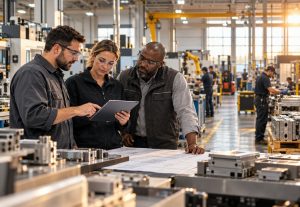
The tolerances involved in aerospace manufacturing are often measured in thousandths of an inch, and failures in quality are simply not an option. Aerospace manufacturers and suppliers operate under some of the strictest production and quality standards in the world because reliability and safety are critical.
These standards have ripple effects across the broader manufacturing economy. Many technologies and manufacturing processes first refined in aerospace eventually influence industries like automotive, energy, defense, heavy equipment, and medical manufacturing.
In many ways, aerospace helps define what advanced manufacturing looks like in America.
Skilled Labor Keeps Aerospace Moving
While the industry is driven by cutting-edge technology, aerospace manufacturing still depends heavily on skilled tradespeople.
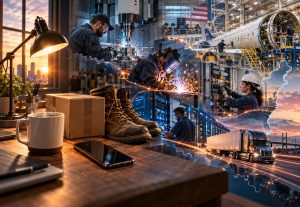
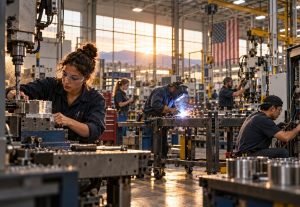
Machinists, welders, inspectors, assemblers, maintenance technicians, composite specialists, programmers, and engineers all play critical roles in keeping aerospace production moving forward. These are highly specialized positions that often require years of training and experience.
At the same time, manufacturers across the aerospace supply chain continue to face serious labor shortages. Many experienced manufacturing professionals are reaching retirement age, while fewer young workers are entering the skilled trades pipeline.
That creates challenges for aerospace manufacturers trying to meet production schedules, maintain quality standards, and keep up with growing demand across commercial aviation, defense, and space exploration.
How FlexTrades Supports Aerospace Manufacturing
At FlexTrades, we understand the challenges aerospace manufacturers face because we specialize in supplying highly skilled manufacturing talent where it is needed most.
From CNC machinists and welders to engineers, inspectors, and advanced manufacturing technicians, FlexTrades helps aerospace manufacturers and their suppliers solve labor shortages, support production demands, and meet critical deadlines. Our network of some of the most skilled tradespeople in America can be deployed within days to anywhere in the country.
In an industry where precision matters and downtime is costly, having access to experienced manufacturing professionals can make a major difference.
The Future of Manufacturing Is Already Here
Without the aerospace industry, missions like Artemis II would never leave the launch pad. But behind every rocket launch, commercial flight, and aerospace breakthrough is a manufacturing workforce making it possible.
Aerospace is not just another manufacturing sector. It is one of the industries pushing American manufacturing capabilities forward through innovation, precision, and skilled labor. As the industry continues to grow, the need for experienced manufacturing professionals will only become more important.